Ch.19 Enzymes and Vitamins
McMurry - Fundamentals of General, Organic, and Biological Chemistry 8th Edition
McMurry8th EditionFundamentals of General, Organic, and Biological ChemistryISBN: 9780134015187Non è quello che usi tu?Cambia libro di testo
Capitolo 19, Problema 33a

Which of the following is a cofactor and which is a coenzyme?
a. Cu2+

Guida verificata passo dopo passo
1
Understand the difference between a cofactor and a coenzyme: A cofactor is a non-protein chemical compound or metallic ion that is required for an enzyme's activity. A coenzyme, on the other hand, is a specific type of cofactor that is organic (contains carbon) and often derived from vitamins.
Analyze the given substance, Cu²⁺: Copper ion (Cu²⁺) is an inorganic metallic ion, which means it does not contain carbon and is not derived from vitamins.
Determine the classification: Since Cu²⁺ is an inorganic metallic ion, it fits the definition of a cofactor rather than a coenzyme.
Conclude the classification: Cu²⁺ is a cofactor, not a coenzyme.
Remember the distinction for future problems: Cofactors can be either metallic ions (like Cu²⁺) or organic molecules (coenzymes), but coenzymes are always organic and often derived from vitamins.

Risposta video verificata per un problema simile:

Questa soluzione video è stata consigliata dai nostri tutor come utile per risolvere questo problema.
Durata del video:
1m

Concetti chiave

Ecco i concetti essenziali che devi comprendere per rispondere correttamente alla domanda.

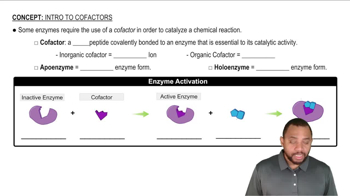
Cofactors

Cofactors are non-protein chemical compounds that are required for the biological activity of a protein, often an enzyme. They can be metal ions, such as Cu²⁺, or organic molecules. Cofactors assist in enzyme function by stabilizing enzyme-substrate complexes or participating in the chemical reactions.
Video consigliato:
Percorso guidato
2:39
Intro to Cofactors Concept 1

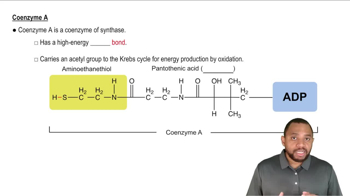
Coenzymes

Coenzymes are a specific type of cofactor that are organic molecules, often derived from vitamins. They bind to enzymes and assist in catalyzing reactions by transferring chemical groups or electrons. Unlike cofactors, coenzymes are usually not permanently attached to the enzyme and can be reused in multiple reactions.
Video consigliato:
Percorso guidato
1:02
Coenzyme A Concept 4

Enzyme Function

Enzymes are biological catalysts that speed up chemical reactions in the body. They require cofactors or coenzymes to achieve their full catalytic potential. Understanding the distinction between cofactors and coenzymes is essential for grasping how enzymes operate and the role of various substances in metabolic processes.
Video consigliato:
Percorso guidato
02:16
Logarithmic Functions