Ch.20 Carbohydrates
McMurry - Fundamentals of General, Organic, and Biological Chemistry 8th Edition
McMurry8th EditionFundamentals of General, Organic, and Biological ChemistryISBN: 9780134015187Non è quello che usi tu?Cambia libro di testo
Capitolo 20, Problema 25

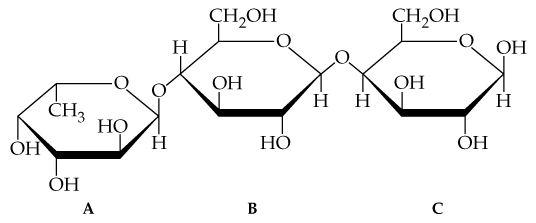
Are one or more of the disaccharides maltose, lactose, cellobiose, and sucrose part of the trisaccharide in Problem 20.23? If so, identify which disaccharide and its location. (Hint: Look for an α-1,4 link, β-1,4 link, or 1,2 link, and then determine if the correct monosaccharides are present.)

Guida verificata passo dopo passo
1
Step 1: Review the structure of the trisaccharide in Problem 20.23. Identify the glycosidic linkages present in the trisaccharide, such as α-1,4, β-1,4, or 1,2 linkages, as these are key to determining if any of the disaccharides are part of the structure.
Step 2: Recall the structures of the disaccharides maltose, lactose, cellobiose, and sucrose. Maltose contains an α-1,4 linkage between two glucose molecules. Lactose contains a β-1,4 linkage between galactose and glucose. Cellobiose contains a β-1,4 linkage between two glucose molecules. Sucrose contains a 1,2 linkage between glucose and fructose.
Step 3: Compare the glycosidic linkages in the trisaccharide to those in the disaccharides. Look for matching linkages (e.g., α-1,4, β-1,4, or 1,2) and ensure that the correct monosaccharides are present in the trisaccharide.
Step 4: If a matching glycosidic linkage and the correct monosaccharides are found, identify the disaccharide that corresponds to that portion of the trisaccharide. For example, if an α-1,4 linkage between two glucose molecules is present, it indicates maltose.
Step 5: Determine the location of the identified disaccharide within the trisaccharide structure. This could involve identifying whether it is at the reducing end, non-reducing end, or in the middle of the trisaccharide.

Risposta video verificata per un problema simile:

Questa soluzione video è stata consigliata dai nostri tutor come utile per risolvere questo problema.
Durata del video:
4m

Concetti chiave

Ecco i concetti essenziali che devi comprendere per rispondere correttamente alla domanda.

Disaccharides

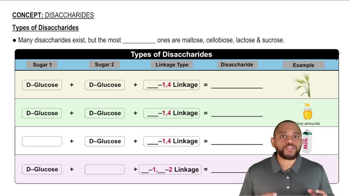
Disaccharides are carbohydrates formed by the condensation of two monosaccharides, linked by glycosidic bonds. Common examples include maltose (glucose + glucose), lactose (glucose + galactose), cellobiose (glucose + glucose), and sucrose (glucose + fructose). Understanding the structure and composition of these disaccharides is essential for identifying their role in larger carbohydrate structures, such as trisaccharides.
Video consigliato:
Percorso guidato
3:39
Types of Disaccharides Concept 1

Glycosidic Linkages

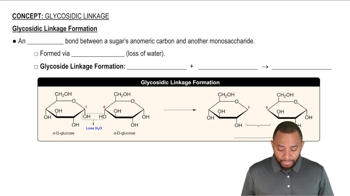
Glycosidic linkages are covalent bonds that connect monosaccharides to form disaccharides and polysaccharides. The type of linkage, such as α-1,4, ß-1,4, or 1,2, determines the properties and digestibility of the carbohydrate. Identifying these linkages is crucial for understanding how disaccharides can be part of larger carbohydrate structures and their functional roles in biological systems.
Video consigliato:
Percorso guidato
1:44
Glycosidic Linkage Formation Concept 1

Trisaccharides

Trisaccharides are carbohydrates composed of three monosaccharide units linked together by glycosidic bonds. They can be formed from the combination of disaccharides and monosaccharides, and their structure influences their biological function and digestibility. Recognizing the specific disaccharides that contribute to a trisaccharide is key to solving the problem presented in the question.
Video consigliato:
Percorso guidato
3:39
Types of Disaccharides Concept 1