
Ch.20 Carbohydrates
McMurry - Fundamentals of General, Organic, and Biological Chemistry 8th Edition
McMurry8th EditionFundamentals of General, Organic, and Biological ChemistryISBN: 9780134015187Non è quello che usi tu?Cambia libro di testo
Capitolo 20, Problema 23c

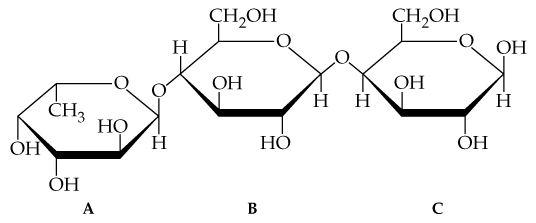
Hydrolysis of both glycosidic bonds in the following trisaccharide A, B, C yields three monosaccharides. 
c. Draw the Fischer projections for the three monosaccharides.

Guida verificata passo dopo passo
1
Identify the structure of the given trisaccharide and locate the glycosidic bonds. Glycosidic bonds are the covalent bonds that link monosaccharides together in a polysaccharide or oligosaccharide.
Understand that hydrolysis involves breaking the glycosidic bonds by adding water molecules. Each glycosidic bond will break, resulting in the release of individual monosaccharides.
Determine the monosaccharides that are released upon hydrolysis. Analyze the structure of the trisaccharide to identify the three monosaccharides (A, B, and C) that are formed.
Recall the Fischer projection, which is a two-dimensional representation of a molecule showing the configuration of chiral centers. For each monosaccharide, draw its Fischer projection by arranging the carbon chain vertically, with the most oxidized carbon (the carbonyl group) at the top.
Ensure that the stereochemistry of each chiral center in the monosaccharides is correctly represented in the Fischer projections. Verify the orientation of hydroxyl (-OH) groups on each carbon atom to match the original structure of the monosaccharides.

Risposta video verificata per un problema simile:

Questa soluzione video è stata consigliata dai nostri tutor come utile per risolvere questo problema.
Durata del video:
6m

Concetti chiave

Ecco i concetti essenziali che devi comprendere per rispondere correttamente alla domanda.

Glycosidic Bonds

Glycosidic bonds are covalent linkages formed between monosaccharides through a dehydration reaction, resulting in the formation of disaccharides or polysaccharides. In the context of trisaccharides, hydrolysis of these bonds breaks them down into individual monosaccharides, which are the simplest form of carbohydrates. Understanding the structure and function of glycosidic bonds is essential for analyzing carbohydrate chemistry.
Video consigliato:
Percorso guidato
1:44
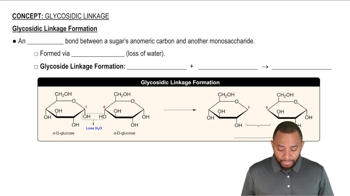
Glycosidic Linkage Formation Concept 1

Hydrolysis

Hydrolysis is a chemical reaction that involves the breaking of a bond in a molecule using water. In carbohydrate chemistry, hydrolysis of glycosidic bonds leads to the release of monosaccharides from polysaccharides or oligosaccharides. This process is crucial for understanding how complex carbohydrates are metabolized and utilized by living organisms.
Video consigliato:
Percorso guidato
1:12
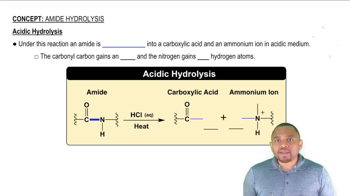
Acidic Hydrolysis Concept 1

Fischer Projections

Fischer projections are a two-dimensional representation of three-dimensional organic molecules, particularly useful for depicting the stereochemistry of carbohydrates. In these projections, the carbon skeleton is arranged vertically, with functional groups extending horizontally. Drawing Fischer projections for monosaccharides allows for a clear visualization of their structural configuration, including the orientation of hydroxyl groups and the anomeric carbon.
Video consigliato:
Percorso guidato
0:48
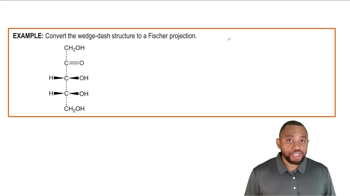
Fischer Projections Example 1