
Are one or more of the disaccharides maltose, lactose, cellobiose, and sucrose part of the trisaccharide in Problem 20.23? If so, identify which disaccharide and its location. (Hint: Look for an α-1,4 link, β-1,4 link, or 1,2 link, and then determine if the correct monosaccharides are present.)
Ch.20 Carbohydrates
McMurry8th EditionFundamentals of General, Organic, and Biological ChemistryISBN: 9780134015187Non è quello che usi tu?Cambia libro di testo
Capitolo 20, Problema 31c
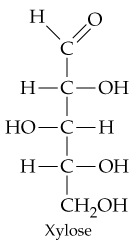
Classify the four carbohydrates (a)–(d) by indicating the nature of the carbonyl group and the number of carbon atoms present. For example, glucose is an aldohexose.
c. 
Guida verificata passo dopo passo1
Step 1: Understand the classification of carbohydrates. Carbohydrates are classified based on two main criteria: (1) the type of carbonyl group present (aldehyde or ketone), and (2) the number of carbon atoms in the molecule. For example, an 'aldohexose' is a carbohydrate with an aldehyde group and six carbon atoms.
Step 2: Examine the structure of the carbohydrate provided in the image. Look for the functional group that contains the carbonyl (C=O) group. If the carbonyl group is at the end of the molecule, it is an aldehyde, and the carbohydrate is classified as an 'aldo-'. If the carbonyl group is within the chain, it is a ketone, and the carbohydrate is classified as a 'keto-'.
Step 3: Count the number of carbon atoms in the carbohydrate structure. This will determine the second part of the name. For example, if there are three carbons, it is a 'triose'; if there are six carbons, it is a 'hexose'.
Step 4: Combine the two pieces of information (type of carbonyl group and number of carbons) to classify the carbohydrate. For example, if the molecule has an aldehyde group and six carbons, it is an aldohexose.
Step 5: Repeat the process for each carbohydrate (a)–(d) in the problem. Carefully analyze the structure of each molecule to determine its classification based on the criteria outlined above.

Risposta video verificata per un problema simile:
Questa soluzione video è stata consigliata dai nostri tutor come utile per risolvere questo problema.
Durata del video:
1mConcetti chiave
Ecco i concetti essenziali che devi comprendere per rispondere correttamente alla domanda.
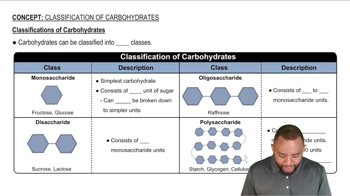
Carbohydrate Classification
Carbohydrates are classified based on the type of carbonyl group they contain and the number of carbon atoms. They can be categorized as aldoses, which have an aldehyde group, or ketoses, which have a ketone group. Additionally, the number of carbon atoms determines whether they are classified as triose (3), tetrose (4), pentose (5), hexose (6), etc.
Video consigliato:
Percorso guidato
Classification of Carbohydrates Example 1
Carbonyl Group
The carbonyl group is a functional group consisting of a carbon atom double-bonded to an oxygen atom (C=O). In carbohydrates, the position of the carbonyl group is crucial for classification: if it is at the end of the carbon chain, the carbohydrate is an aldose; if it is within the chain, it is a ketose. This distinction affects the chemical properties and reactivity of the carbohydrate.
Video consigliato:
Percorso guidato
Functional Groups with Carbonyls Example 3
Structural Representation of Carbohydrates
Carbohydrates can be represented structurally in various forms, including linear and cyclic structures. The linear form shows the arrangement of carbon atoms and functional groups, while the cyclic form, which is more common in solution, illustrates how the carbonyl group reacts with a hydroxyl group to form a ring. Understanding these structures is essential for identifying the type and classification of carbohydrates.
Video consigliato:
Percorso guidato
Classification of Carbohydrates Concept 1
Pratica correlata
Domanda del libro di testo
1048
views
Domanda del libro di testo
Hydrolysis of both glycosidic bonds in the following trisaccharide A, B, C yields three monosaccharides.
c. Draw the Fischer projections for the three monosaccharides.
664
views
Domanda del libro di testo
How many chiral carbon atoms are present in each of the molecules shown in Problem 20.31?
a.
b.
c.
d.
683
views
Domanda del libro di testo
Draw the open-chain structure of a 4-carbon deoxy sugar.
1445
views
Domanda del libro di testo
Classify the four carbohydrates (a)–(d) by indicating the nature of the carbonyl group and the number of carbon atoms present. For example, glucose is an aldohexose.
d.
931
views
Domanda del libro di testo
In solution, glucose exists predominantly in the cyclic hemiacetal form, which does not contain an aldehyde group. How is it possible for mild oxidizing agents to oxidize glucose?
772
views
