Lactate can be converted into pyruvate by the enzyme lactate dehydrogenase and the coenzyme NAD+. Write the reaction in the standard biochemical format, using a curved arrow to show the involvement of NAD+.
Ch.22 Carbohydrate Metabolism
McMurry8th EditionFundamentals of General, Organic, and Biological ChemistryISBN: 9780134015187Non è quello che usi tu?Cambia libro di testo
Capitolo 22, Problema 47a
How many moles of ATP are produced by phosphorylation in the following?
a. Glycolysis of 1 mol of glucose
Guida verificata passo dopo passo1
Understand the process of glycolysis: Glycolysis is the metabolic pathway that breaks down 1 molecule of glucose (C₆H₁₂O₆) into 2 molecules of pyruvate. During this process, ATP is both consumed and produced.
Identify the net ATP production in glycolysis: Glycolysis consumes 2 ATP molecules in its initial steps (energy investment phase) and produces 4 ATP molecules in its later steps (energy payoff phase). The net production of ATP is therefore 4 - 2 = 2 ATP molecules per glucose molecule.
Relate ATP production to moles: Since the problem specifies 1 mole of glucose, the net ATP production will be directly proportional. For every 1 mole of glucose, 2 moles of ATP are produced.
Express the relationship mathematically: The net ATP production can be written as: \( \text{Net ATP} = 2 \times \text{moles of glucose} \). Substituting 1 mole of glucose, \( \text{Net ATP} = 2 \times 1 = 2 \text{ moles of ATP} \).
Conclude the calculation: The glycolysis of 1 mole of glucose results in the production of 2 moles of ATP through phosphorylation.

Risposta video verificata per un problema simile:
Questa soluzione video è stata consigliata dai nostri tutor come utile per risolvere questo problema.
Durata del video:
1mConcetti chiave
Ecco i concetti essenziali che devi comprendere per rispondere correttamente alla domanda.
Glycolysis
Glycolysis is a metabolic pathway that converts glucose into pyruvate, producing energy in the form of ATP. This process occurs in the cytoplasm and involves a series of enzymatic reactions. For each molecule of glucose, glycolysis typically yields a net gain of 2 ATP molecules through substrate-level phosphorylation.
Video consigliato:
Percorso guidato
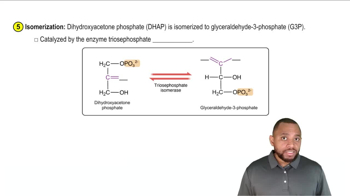
Glycolysis Concept 5
ATP Production
Adenosine triphosphate (ATP) is the primary energy carrier in cells. During glycolysis, ATP is produced through substrate-level phosphorylation, where a phosphate group is directly transferred to ADP from a phosphorylated intermediate. Understanding the ATP yield from glycolysis is crucial for evaluating the energy efficiency of cellular respiration.
Video consigliato:
Percorso guidato
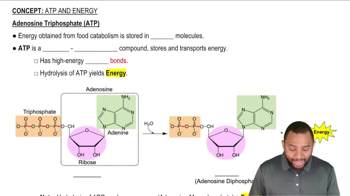
Adenosine Triphosphate (ATP) Concept 2
Phosphorylation
Phosphorylation is the process of adding a phosphate group to a molecule, often to activate or deactivate enzymes and other proteins. In the context of glycolysis, phosphorylation refers to the addition of phosphate groups to glucose and intermediates, which is essential for the energy investment phase and ultimately leads to ATP production.
Video consigliato:
Percorso guidato
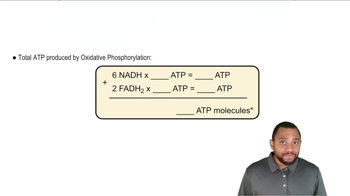
Oxidative Phosphorylation Concept 2
Pratica correlata
Domanda del libro di testo
897
views
Domanda del libro di testo
How many moles of ATP are produced by phosphorylation in the following?
b. Aerobic conversion of 1 mol of pyruvate to 1 mol of acetyl-CoA
633
views
Domanda del libro di testo
Which glycolysis reactions are catalyzed by the following enzymes?
d. Phosphoglycerate mutase
708
views
Domanda del libro di testo
Which glycolysis reactions are catalyzed by the following enzymes?
a. Pyruvate kinase
645
views
Domanda del libro di testo
How many moles of ATP are produced by phosphorylation in the following?
c. Catabolism of 1 mol of acetyl-CoA in the citric acid cycle
738
views
Domanda del libro di testo
Review the 10 steps in glycolysis and then answer the following questions:
c. Which step is a dehydration?
729
views