Ch.22 Carbohydrate Metabolism
McMurry - Fundamentals of General, Organic, and Biological Chemistry 8th Edition
McMurry8th EditionFundamentals of General, Organic, and Biological ChemistryISBN: 9780134015187Non è quello che usi tu?Cambia libro di testo
Capitolo 22, Problema 46c

Review the 10 steps in glycolysis and then answer the following questions:
c. Which step is a dehydration?

Guida verificata passo dopo passo
1
Step 1: Recall that glycolysis is a metabolic pathway consisting of 10 enzymatic steps that convert glucose into pyruvate, producing ATP and NADH in the process.
Step 2: Review the 10 steps of glycolysis, paying close attention to the specific chemical transformations occurring in each step. Focus on identifying the step where a water molecule (H₂O) is removed, as dehydration involves the loss of water.
Step 3: Note that the dehydration step in glycolysis occurs during the conversion of 2-phosphoglycerate to phosphoenolpyruvate (PEP). This reaction is catalyzed by the enzyme enolase.
Step 4: Understand the chemical mechanism of this step: enolase removes a water molecule from 2-phosphoglycerate, resulting in the formation of a double bond and the highly reactive compound phosphoenolpyruvate.
Step 5: Confirm your understanding by reviewing the structure of 2-phosphoglycerate and phosphoenolpyruvate, noting the loss of H₂O and the formation of the double bond in the product.

Risposta video verificata per un problema simile:

Questa soluzione video è stata consigliata dai nostri tutor come utile per risolvere questo problema.
Durata del video:
4m

Concetti chiave

Ecco i concetti essenziali che devi comprendere per rispondere correttamente alla domanda.

Glycolysis

Glycolysis is a metabolic pathway that converts glucose into pyruvate, producing a small amount of ATP and NADH in the process. It consists of ten enzymatic steps, which can be divided into two phases: the energy investment phase and the energy payoff phase. Understanding glycolysis is essential for grasping how cells generate energy from carbohydrates.
Video consigliato:
Percorso guidato
1:26
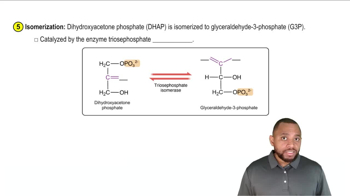
Glycolysis Concept 5

Dehydration Reaction

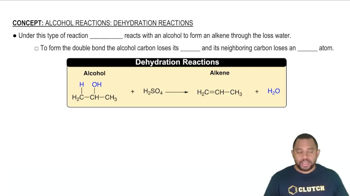
A dehydration reaction, also known as a condensation reaction, involves the removal of a water molecule during the formation of a bond between two molecules. In glycolysis, this type of reaction is crucial for certain steps where substrates are converted into products, facilitating the overall metabolic process. Recognizing where dehydration occurs helps in understanding the biochemical transformations in glycolysis.
Video consigliato:
Percorso guidato
1:30
Alcohol Reactions: Dehydration Reactions Concept 1

Enzymatic Steps in Glycolysis

Each step in glycolysis is catalyzed by a specific enzyme, which facilitates the conversion of substrates into products. These enzymes are critical for regulating the pathway and ensuring that the reactions proceed efficiently. Identifying the specific steps and their corresponding enzymes is vital for understanding the overall process and pinpointing where dehydration reactions occur.
Video consigliato:
Percorso guidato
2:27
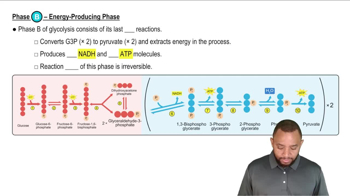
Glycolysis Concept 6