Ch.22 Carbohydrate Metabolism
McMurry - Fundamentals of General, Organic, and Biological Chemistry 8th Edition
McMurry8th EditionFundamentals of General, Organic, and Biological ChemistryISBN: 9780134015187Non è quello che usi tu?Cambia libro di testo
Capitolo 22, Problema 6a

In Figure 22.3, compare the starting compound (glucose) and the final product (pyruvate).
a. Which is oxidized to a greater extent?

Guida verificata passo dopo passo
1
Identify the chemical structures of glucose and pyruvate. Glucose is a six-carbon molecule with the molecular formula C₆H₁₂O₆, while pyruvate is a three-carbon molecule with the molecular formula C₃H₄O₃.
Understand the concept of oxidation in chemistry. Oxidation involves the loss of electrons, which is often accompanied by an increase in the number of bonds to oxygen or a decrease in the number of bonds to hydrogen.
Compare the oxidation states of carbon atoms in glucose and pyruvate. In glucose, the carbon atoms are less oxidized because they are bonded to more hydrogen atoms and fewer oxygen atoms. In pyruvate, the carbon atoms are more oxidized because they are bonded to more oxygen atoms and fewer hydrogen atoms.
Analyze the metabolic pathway of glycolysis, where glucose is converted into two molecules of pyruvate. During this process, electrons are removed from glucose (oxidation) and transferred to electron carriers like NAD⁺, forming NADH.
Conclude that pyruvate is oxidized to a greater extent than glucose because it has more bonds to oxygen and fewer bonds to hydrogen, indicating a higher oxidation state for its carbon atoms.

Risposta video verificata per un problema simile:

Questa soluzione video è stata consigliata dai nostri tutor come utile per risolvere questo problema.
Durata del video:
7m

Concetti chiave

Ecco i concetti essenziali che devi comprendere per rispondere correttamente alla domanda.

Oxidation and Reduction

Oxidation refers to the loss of electrons or an increase in oxidation state by a molecule, atom, or ion. In biochemical processes, it often involves the removal of hydrogen atoms or the addition of oxygen. Understanding oxidation is crucial for comparing compounds like glucose and pyruvate, as it helps determine which compound has undergone a greater degree of oxidation during metabolic pathways.
Video consigliato:
Percorso guidato
0:55
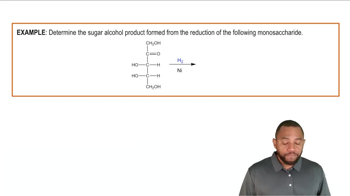
Reduction of Monosaccharides Example 1

Glycolysis

Glycolysis is a metabolic pathway that converts glucose into pyruvate, producing energy in the form of ATP and NADH. This process occurs in the cytoplasm and consists of ten enzyme-catalyzed reactions. Recognizing the steps of glycolysis is essential for understanding how glucose is transformed into pyruvate and the associated changes in oxidation states.
Video consigliato:
Percorso guidato
1:26
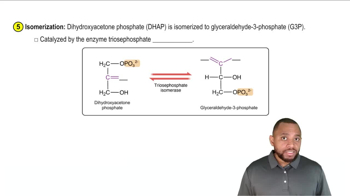
Glycolysis Concept 5

Energy Yield and Electron Carriers

During the conversion of glucose to pyruvate, energy is released and captured in the form of ATP and reduced electron carriers like NADH. The extent of oxidation can be assessed by examining the number of electrons transferred to these carriers. This concept is vital for evaluating the energy dynamics of the reaction and understanding the overall efficiency of glucose metabolism.
Video consigliato: