Ch.22 Carbohydrate Metabolism
McMurry - Fundamentals of General, Organic, and Biological Chemistry 8th Edition
McMurry8th EditionFundamentals of General, Organic, and Biological ChemistryISBN: 9780134015187Non è quello che usi tu?Cambia libro di testo
Capitolo 22, Problema 7

Use curved arrows (like those in Figure 22.3) to write an equation for the conversion of fructose to fructose 6-phosphate by ATP. At what step does fructose 6-phosphate enter glycolysis?

Guida verificata passo dopo passo
1
Understand the reaction: The conversion of fructose to fructose 6-phosphate involves the transfer of a phosphate group from ATP to fructose. This is a phosphorylation reaction catalyzed by an enzyme, typically a kinase.
Draw the structures: Represent the structure of fructose and ATP. Fructose is a six-carbon sugar, and ATP (adenosine triphosphate) contains three phosphate groups. Identify the hydroxyl group on the fructose molecule that will accept the phosphate group.
Use curved arrows: Use curved arrows to show the movement of electrons during the reaction. Specifically, show the nucleophilic attack of the hydroxyl group on the terminal phosphate group of ATP, leading to the formation of fructose 6-phosphate and ADP (adenosine diphosphate).
Write the chemical equation: Represent the reaction as follows: Fructose6+ATP3→Fructose6-phosphate1+ADP2.
Determine glycolysis entry: Fructose 6-phosphate enters glycolysis at the second step of the pathway, where it is converted to fructose 1,6-bisphosphate by the enzyme phosphofructokinase.

Risposta video verificata per un problema simile:

Questa soluzione video è stata consigliata dai nostri tutor come utile per risolvere questo problema.
Durata del video:
7m

Concetti chiave

Ecco i concetti essenziali che devi comprendere per rispondere correttamente alla domanda.

Curved Arrows in Organic Chemistry

Curved arrows are used in organic chemistry to represent the movement of electrons during chemical reactions. They indicate the direction of electron flow, helping to visualize how bonds are formed or broken. In the context of converting fructose to fructose 6-phosphate, these arrows illustrate the transfer of a phosphate group from ATP to fructose.
Video consigliato:
Percorso guidato
2:26
Introduction to Organic Chemistry Concept 1

Phosphorylation

Phosphorylation is the process of adding a phosphate group to a molecule, which often alters the molecule's function and activity. In this case, ATP donates a phosphate group to fructose, converting it into fructose 6-phosphate. This modification is crucial for activating the sugar for subsequent metabolic pathways, such as glycolysis.
Video consigliato:
Percorso guidato
0:51
Oxidative Phosphorylation Concept 2

Glycolysis Entry Point

Fructose 6-phosphate is an important intermediate in glycolysis, entering the pathway after its formation from fructose. It is converted into fructose 1,6-bisphosphate by the enzyme phosphofructokinase, marking a key regulatory step in glycolysis. Understanding this entry point is essential for grasping how carbohydrates are metabolized for energy.
Video consigliato:
Percorso guidato
1:26
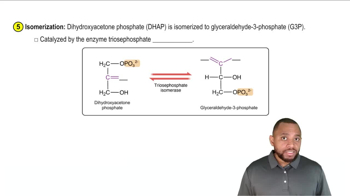
Glycolysis Concept 5