
Ch.23 Lipids
McMurry - Fundamentals of General, Organic, and Biological Chemistry 8th Edition
McMurry8th EditionFundamentals of General, Organic, and Biological ChemistryISBN: 9780134015187Non è quello che usi tu?Cambia libro di testo
Capitolo 23, Problema 23

A membrane lipid was isolated and completely hydrolyzed. The following products were detected: ethanolamine, phosphate, glycerol, palmitic acid, and oleic acid. Propose a structure for this membrane lipid, and name the family to which it belongs.

Guida verificata passo dopo passo
1
Identify the components of the membrane lipid based on the hydrolysis products: ethanolamine, phosphate, glycerol, palmitic acid, and oleic acid. These components suggest the lipid is a phospholipid, as it contains a phosphate group and glycerol backbone.
Recall the general structure of a phospholipid: it consists of a glycerol backbone, two fatty acid chains (hydrophobic tails), and a polar head group that includes a phosphate group and an additional molecule (in this case, ethanolamine).
Assign the fatty acids to the glycerol backbone. Palmitic acid (a saturated fatty acid) and oleic acid (an unsaturated fatty acid) will be esterified to the first and second hydroxyl groups of glycerol, respectively.
Attach the phosphate group to the third hydroxyl group of glycerol. Then, link the ethanolamine molecule to the phosphate group to form the polar head group. This structure is characteristic of a phosphatidylethanolamine.
Conclude that the membrane lipid belongs to the phospholipid family, specifically the phosphatidylethanolamine subclass, as it contains ethanolamine as the polar head group.

Risposta video verificata per un problema simile:

Questa soluzione video è stata consigliata dai nostri tutor come utile per risolvere questo problema.
Durata del video:
1m

Concetti chiave

Ecco i concetti essenziali che devi comprendere per rispondere correttamente alla domanda.

Phospholipids

Phospholipids are a class of lipids that are a major component of all cell membranes. They consist of a glycerol backbone, two fatty acid tails, and a phosphate group. The hydrophilic (water-attracting) phosphate head and hydrophobic (water-repelling) fatty acid tails create a bilayer structure that is fundamental to membrane integrity and function.
Video consigliato:
Percorso guidato
1:01
Glycerophospholipids Example 1

Fatty Acids

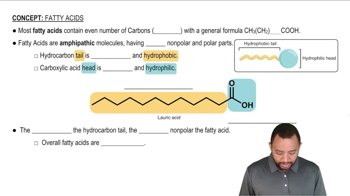
Fatty acids are long hydrocarbon chains that can be saturated (no double bonds) or unsaturated (one or more double bonds). In the context of membrane lipids, the presence of palmitic acid (a saturated fatty acid) and oleic acid (an unsaturated fatty acid) influences the fluidity and flexibility of the membrane, affecting its overall properties and functionality.
Video consigliato:
Percorso guidato
2:00
Fatty Acids Concept 1

Glycerol Backbone

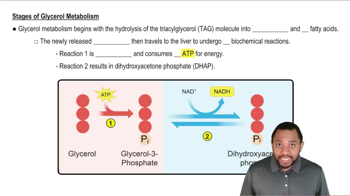
The glycerol backbone is a three-carbon molecule that serves as the structural foundation for various lipids, including triglycerides and phospholipids. In phospholipids, two of the hydroxyl groups of glycerol are esterified with fatty acids, while the third is linked to a phosphate group, which can further bond to other molecules like ethanolamine, contributing to the lipid's identity and function.
Video consigliato:
Percorso guidato
1:20
Glycerol Metabolism Concept 2