Ch.23 Lipids
McMurry - Fundamentals of General, Organic, and Biological Chemistry 8th Edition
McMurry8th EditionFundamentals of General, Organic, and Biological ChemistryISBN: 9780134015187Non è quello che usi tu?Cambia libro di testo
Capitolo 23, Problema 31

Are the carbon–carbon double bonds in naturally occurring fatty acids primarily cis or trans?

Guida verificata passo dopo passo
1
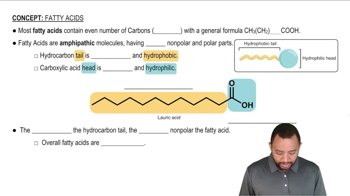
Understand the structure of fatty acids: Fatty acids are long hydrocarbon chains with a carboxylic acid group (-COOH) at one end. Some fatty acids contain carbon–carbon double bonds, which can exist in either cis or trans configurations.
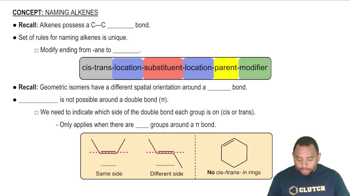
Define the cis and trans configurations: In a cis configuration, the hydrogen atoms attached to the carbon atoms of the double bond are on the same side of the molecule. In a trans configuration, the hydrogen atoms are on opposite sides of the molecule.
Recognize the natural occurrence of cis bonds: In naturally occurring unsaturated fatty acids, the carbon–carbon double bonds are predominantly in the cis configuration. This causes a bend or kink in the fatty acid chain, which affects the physical properties of the molecule.
Explain the significance of cis bonds: The cis configuration in natural fatty acids contributes to their liquid state at room temperature (e.g., oils) because the kinks prevent tight packing of the molecules.
Note the exception of trans fats: Trans double bonds are typically found in artificially hydrogenated fats and are less common in nature. These trans fats have a straighter structure, similar to saturated fats, and are associated with different health effects.

Risposta video verificata per un problema simile:

Questa soluzione video è stata consigliata dai nostri tutor come utile per risolvere questo problema.
Durata del video:
2m

Concetti chiave

Ecco i concetti essenziali che devi comprendere per rispondere correttamente alla domanda.

Cis and Trans Isomerism

Cis and trans isomerism refers to the spatial arrangement of atoms in a molecule. In cis isomers, similar groups are on the same side of a double bond, while in trans isomers, they are on opposite sides. This difference in configuration can significantly affect the physical properties and biological functions of fatty acids.
Video consigliato:
Percorso guidato
2:47
Rules for Naming Alkenes Concept 1

Fatty Acid Structure

Fatty acids are carboxylic acids with long hydrocarbon chains, which can be saturated or unsaturated. Unsaturated fatty acids contain one or more double bonds between carbon atoms. The presence and configuration of these double bonds influence the melting point, fluidity, and overall function of the fatty acids in biological systems.
Video consigliato:
Percorso guidato
0:55
Fatty Acids Example 1

Biological Significance of Fatty Acids

The configuration of double bonds in fatty acids has important implications for health and nutrition. Cis fatty acids are typically found in natural fats and oils, contributing to fluidity in cell membranes, while trans fatty acids, often found in processed foods, are associated with negative health effects. Understanding these configurations helps in assessing dietary impacts on health.
Video consigliato:
Percorso guidato
2:00
Fatty Acids Concept 1