Ch.23 Lipids
McMurry - Fundamentals of General, Organic, and Biological Chemistry 8th Edition
McMurry8th EditionFundamentals of General, Organic, and Biological ChemistryISBN: 9780134015187Non è quello che usi tu?Cambia libro di testo
Capitolo 23, Problema 29

Draw an 18-carbon unsaturated fatty acid that contains two carbon–carbon double bonds, one on carbon 6 and one on carbon 9 (count starting with the carboxyl carbon). Is this a “straight-chain” molecule or a “bent” molecule?

Guida verificata passo dopo passo
1
Step 1: Begin by understanding the structure of a fatty acid. A fatty acid consists of a carboxyl group (-COOH) at one end and a long hydrocarbon chain. In this case, the chain contains 18 carbons.
Step 2: Identify the positions of the double bonds. The problem specifies that there are two carbon–carbon double bonds: one at carbon 6 and one at carbon 9. Number the carbon atoms starting from the carboxyl carbon (carbon 1).
Step 3: Draw the hydrocarbon chain with single bonds between carbons initially. Then, introduce the double bonds at the specified positions: between carbon 6 and carbon 7, and between carbon 9 and carbon 10. Ensure the rest of the carbons are connected by single bonds.
Step 4: Determine the geometry around the double bonds. Carbon–carbon double bonds in fatty acids typically have a cis configuration, which causes a bend in the molecule at each double bond. Draw the chain with bends at the positions of the double bonds to reflect this geometry.
Step 5: Conclude whether the molecule is 'straight-chain' or 'bent.' Since the cis double bonds introduce bends in the structure, this molecule is not a straight-chain molecule but a bent one.

Risposta video verificata per un problema simile:

Questa soluzione video è stata consigliata dai nostri tutor come utile per risolvere questo problema.
Durata del video:
3m

Concetti chiave

Ecco i concetti essenziali che devi comprendere per rispondere correttamente alla domanda.

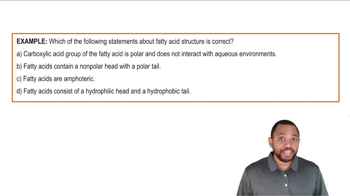
Fatty Acid Structure

Fatty acids are carboxylic acids with long hydrocarbon chains. The structure includes a carboxyl group (-COOH) at one end, followed by a chain of carbon atoms. In unsaturated fatty acids, one or more double bonds exist between carbon atoms, affecting the molecule's shape and properties.
Video consigliato:
Percorso guidato
0:55
Fatty Acids Example 1

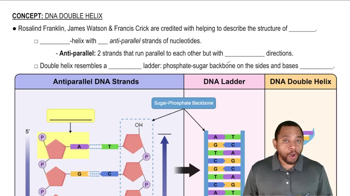
Unsaturation and Double Bonds

Unsaturation refers to the presence of double bonds in a fatty acid chain. Each double bond introduces a kink in the chain, preventing tight packing of the molecules. In this case, the presence of two double bonds at specific positions (carbon 6 and carbon 9) indicates that the fatty acid is unsaturated and will have a bent shape.
Video consigliato:
Percorso guidato
3:27
DNA Double Helix Concept 1

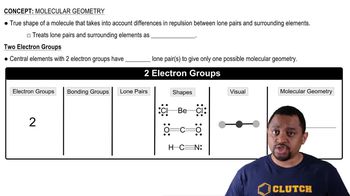
Molecular Geometry

Molecular geometry describes the three-dimensional arrangement of atoms in a molecule. In the case of fatty acids, the presence of double bonds leads to a bent or kinked structure, as opposed to a straight-chain configuration. This geometric difference influences the physical properties of the fatty acid, such as melting point and fluidity.
Video consigliato:
Percorso guidato
01:30
Molecular Geometry (Simplified) Concept 1