Ch.23 Lipids
McMurry - Fundamentals of General, Organic, and Biological Chemistry 8th Edition
McMurry8th EditionFundamentals of General, Organic, and Biological ChemistryISBN: 9780134015187Non è quello che usi tu?Cambia libro di testo
Capitolo 23, Problema 8

Write an equation for the complete hydrogenation of triolein, the triacylglycerol with three oleic acid acyl groups for which you drew the structure in Problem 23.3. Name the fatty acid from which the resulting acyl groups are derived.

Guida verificata passo dopo passo
1
Identify the structure of triolein: Triolein is a triacylglycerol composed of glycerol esterified with three oleic acid molecules. Oleic acid is a monounsaturated fatty acid with the formula C₁₈H₃₄O₂, containing one double bond in its hydrocarbon chain.
Understand the process of hydrogenation: Complete hydrogenation involves the addition of hydrogen (H₂) across the double bonds in the unsaturated fatty acid chains, converting them into saturated fatty acid chains. This reaction is typically catalyzed by a metal catalyst such as nickel (Ni).
Write the chemical equation for the hydrogenation reaction: Represent triolein as C₅₇H₁₀₄O₆ (the molecular formula for a triacylglycerol with three oleic acid groups). Add three molecules of hydrogen (H₂) for each double bond present in the triolein molecule. The product will be a triacylglycerol with three stearic acid groups, as the double bonds are fully saturated.
Express the reaction in equation form: C57H104O6 + 3H2 → C57H110O6
Name the resulting fatty acid: The resulting acyl groups are derived from stearic acid, a saturated fatty acid with the formula C₁₈H₃₆O₂. Stearic acid is the fully hydrogenated form of oleic acid.

Risposta video verificata per un problema simile:

Questa soluzione video è stata consigliata dai nostri tutor come utile per risolvere questo problema.
Durata del video:
5m

Concetti chiave

Ecco i concetti essenziali che devi comprendere per rispondere correttamente alla domanda.

Triolein Structure

Triolein is a triacylglycerol composed of three oleic acid molecules. Each oleic acid contributes a long hydrocarbon chain with a double bond, making triolein unsaturated. Understanding its structure is crucial for predicting the products of hydrogenation, which involves the addition of hydrogen to the double bonds, converting them into single bonds.
Video consigliato:
Percorso guidato
1:01
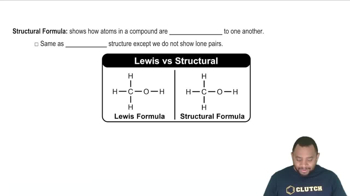
Structural Formula Concept 2

Hydrogenation Process

Hydrogenation is a chemical reaction that involves the addition of hydrogen (H2) to unsaturated fats, resulting in the conversion of double bonds to single bonds. This process typically occurs in the presence of a catalyst, such as nickel or platinum, and is used to solidify liquid oils. In the case of triolein, complete hydrogenation will yield a saturated fat, specifically tristearin.
Video consigliato:
Percorso guidato
0:49
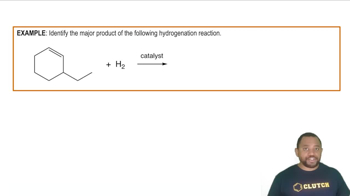
Hydrogenation Reactions Example 1

Fatty Acid Derivation

The fatty acids derived from the hydrogenation of triolein are saturated fatty acids. In this case, the resulting acyl groups after complete hydrogenation are derived from stearic acid, which has a straight-chain structure with no double bonds. Recognizing the relationship between the original unsaturated fatty acids and the resulting saturated fatty acids is essential for naming and understanding the products of the reaction.
Video consigliato:
Percorso guidato
2:00
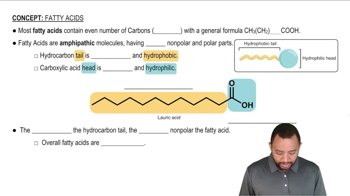
Fatty Acids Concept 1