Draw the complete structural formula of arachidonic acid (Table 23.1) in a way that shows the cis stereochemistry of its four double bonds.
Ch.23 Lipids
McMurry8th EditionFundamentals of General, Organic, and Biological ChemistryISBN: 9780134015187Non è quello che usi tu?Cambia libro di testo
Capitolo 23, Problema 11
Write the complete equation for the hydrolysis of a triacylglycerol in which the fatty acids are two molecules of stearic acid and one of oleic acid.
Guida verificata passo dopo passo1
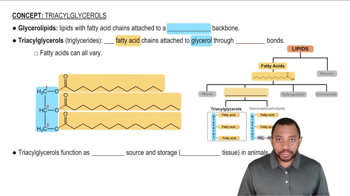
Identify the structure of a triacylglycerol: A triacylglycerol consists of a glycerol backbone esterified to three fatty acid molecules. In this case, the fatty acids are two molecules of stearic acid (C18H36O2, a saturated fatty acid) and one molecule of oleic acid (C18H34O2, a monounsaturated fatty acid).
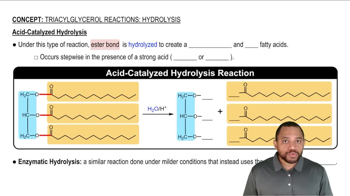
Understand the hydrolysis reaction: Hydrolysis of a triacylglycerol involves breaking the ester bonds between the glycerol backbone and the fatty acids using water (H2O) in the presence of an enzyme (lipase) or a strong base/acid catalyst.
Write the reactants: The reactants are the triacylglycerol (glycerol esterified with two stearic acid molecules and one oleic acid molecule) and three molecules of water (H2O).
Write the products: The hydrolysis reaction produces one molecule of glycerol (C3H8O3) and three free fatty acids: two molecules of stearic acid (C18H36O2) and one molecule of oleic acid (C18H34O2).
Combine the information into a complete balanced chemical equation: The equation is: . This represents the hydrolysis of the triacylglycerol into its components.

Risposta video verificata per un problema simile:
Questa soluzione video è stata consigliata dai nostri tutor come utile per risolvere questo problema.
Durata del video:
5mConcetti chiave
Ecco i concetti essenziali che devi comprendere per rispondere correttamente alla domanda.
Triacylglycerol Structure
Triacylglycerols, also known as triglycerides, are esters formed from glycerol and three fatty acid molecules. In this case, the structure consists of a glycerol backbone bonded to two stearic acid (C18:0) molecules and one oleic acid (C18:1) molecule. Understanding the structure is essential for writing the hydrolysis equation.
Video consigliato:
Percorso guidato
Triacylglycerols Concept 1
Hydrolysis Reaction
Hydrolysis is a chemical reaction that involves the breakdown of a compound by water. In the context of triacylglycerols, hydrolysis results in the release of glycerol and free fatty acids. This reaction is catalyzed by enzymes such as lipases and is crucial for understanding how fats are metabolized in the body.
Video consigliato:
Percorso guidato
Triacylglycerol Reactions: Hydrolysis Concept 1
Fatty Acid Composition
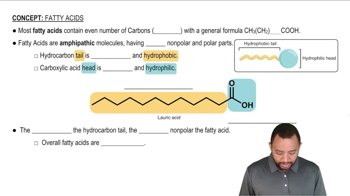
Fatty acids are carboxylic acids with long hydrocarbon chains, and their properties depend on their saturation and length. Stearic acid is a saturated fatty acid, while oleic acid is unsaturated. Recognizing the types of fatty acids involved in the hydrolysis of triacylglycerols is important for accurately representing the products of the reaction.
Video consigliato:
Percorso guidato
Fatty Acids Concept 1
Pratica correlata
Domanda del libro di testo
724
views
Domanda del libro di testo
Write an equation for the complete hydrogenation of triolein, the triacylglycerol with three oleic acid acyl groups for which you drew the structure in Problem 23.3. Name the fatty acid from which the resulting acyl groups are derived.
851
views
Domanda del libro di testo
Identify the products formed by complete hydrolysis of all ester bonds in (a) the phosphatidylcholine on page 726.
726
views
Domanda del libro di testo
Draw the structure of the sphingomyelin that contains a myristic acid acyl group. Identify the hydrophilic head group and the hydrophobic tails in this molecule.
747
views
Domanda del libro di testo
Identify the products formed by complete hydrolysis of all ester bonds in (b) the sphingomyelin in Figure 23.5.
746
views
Domanda del libro di testo
Can there be any chiral carbon atoms in triacylglycerols? If so, which ones can be chiral and what determines their chirality?
1340
views