Indietro
Problema 62
Draw the structure of a glycerophospholipid that contains palmitic acid, oleic acid, and the phosphate bonded to propanolamine.
Problema 63
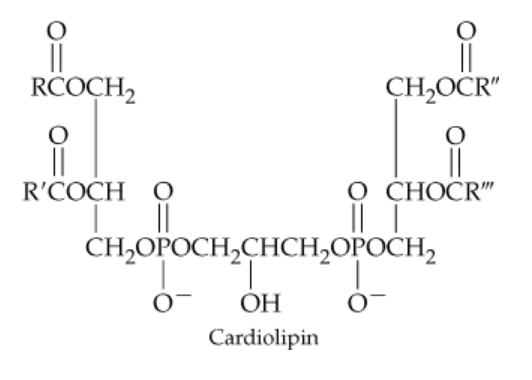
Cardiolipin, a compound found in heart muscle, has the following structure. What products are formed if all ester bonds in the molecule are saponified by treatment with aqueous NaOH?
Problema 72
Which process requires energy—passive or active transport? Why is energy sometimes required to move solute across the cell membrane?
Problema 74a
Based on the information in Section 23.7, how would you expect each of these common metabolites to cross the cell membrane?
a. NO (nitrous oxide)
Problema 74c
Based on the information in Section 23.7, how would you expect each of these common metabolites to cross the cell membrane?
c. Ca2+
Problema 75a
Based on the information in Section 23.7, how would you expect each of these common metabolites to cross the cell membrane?
a. CO
Problema 76
Which of the following are saponifiable lipids? (Recall that ester bonds are broken by base hydrolysis.)
a. Progesterone
b. Glyceryl trioleate
c. A sphingomyelin
d. Prostaglandin E1
e. A cerebroside
f. A lecithin
Problema 77
Identify the component parts of each saponifiable lipid listed in Problem 23.76.
a. Progesterone
b. Glyceryl trioleate
c. A sphingomyelin
d. Prostaglandin
e. A cerebroside
f. A lecithin
Problema 78
Draw the structure of a triacylglycerol made from two molecules of myristic acid and one molecule of linolenic acid.
Problema 82
Draw cholesterol acetate. Is this molecule saponifiable? Explain.
Problema 86
If the average molar mass of a sample of soybean oil is 1500 g/mol, how many grams of NaOH are needed to saponify 5.0 g of the oil?
Problema 87
The concentration of cholesterol in the blood serum of a normal adult is approximately 200 mg/dL. How many grams of cholesterol does a person with a blood volume of 5.75 L have circulating in his or her blood? (You may need to review Chapter 1.)