
Ch.25 Protein and Amino Acid Metabolism
McMurry - Fundamentals of General, Organic, and Biological Chemistry 8th Edition
McMurry8th EditionFundamentals of General, Organic, and Biological ChemistryISBN: 9780134015187Non è quello che usi tu?Cambia libro di testo
Capitolo 25, Problema 20

What citric acid cycle intermediates are precursors to amino acids?

Guida verificata passo dopo passo
1
Understand that the citric acid cycle (also known as the Krebs cycle or TCA cycle) is a central metabolic pathway that not only generates energy but also provides intermediates for biosynthetic processes, including amino acid synthesis.
Identify the intermediates in the citric acid cycle that can serve as precursors for amino acids. These intermediates include oxaloacetate, α-ketoglutarate, and fumarate.
Explain that oxaloacetate is a precursor for aspartate, which can further lead to the synthesis of other amino acids such as asparagine, methionine, lysine, and threonine.
Explain that α-ketoglutarate is a precursor for glutamate, which can be used to synthesize other amino acids such as glutamine, proline, and arginine.
Explain that fumarate, while not directly a precursor, is part of the metabolic pathways that connect to amino acid synthesis, particularly through its role in the urea cycle and other transamination reactions.

Risposta video verificata per un problema simile:

Questa soluzione video è stata consigliata dai nostri tutor come utile per risolvere questo problema.
Durata del video:
5m

Concetti chiave

Ecco i concetti essenziali che devi comprendere per rispondere correttamente alla domanda.

Citric Acid Cycle (Krebs Cycle)

The citric acid cycle, also known as the Krebs cycle, is a series of chemical reactions used by all aerobic organisms to generate energy. It occurs in the mitochondria and involves the oxidation of acetyl-CoA to produce ATP, NADH, and FADH2. This cycle is crucial for cellular respiration and provides intermediates that serve as building blocks for various biomolecules, including amino acids.
Video consigliato:
Percorso guidato
2:31
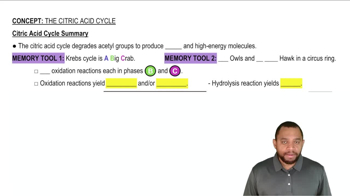
Citric Acid Cycle Summary Concept 12

Amino Acid Biosynthesis

Amino acid biosynthesis refers to the process by which cells create amino acids, the building blocks of proteins. Certain intermediates from the citric acid cycle, such as α-ketoglutarate and oxaloacetate, can be converted into specific amino acids through transamination and other biochemical pathways. Understanding this relationship is essential for grasping how metabolic pathways are interconnected.
Video consigliato:
Percorso guidato
3:03
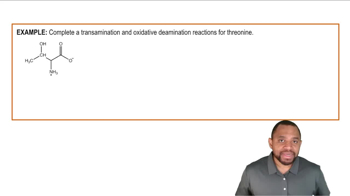
Amino Acid Catabolism: Amino Group Example 2

Metabolic Intermediates

Metabolic intermediates are compounds that form during the metabolic processes of cells, acting as substrates or products in various biochemical reactions. In the context of the citric acid cycle, intermediates like citrate, α-ketoglutarate, and succinyl-CoA play pivotal roles not only in energy production but also as precursors for synthesizing amino acids and other important biomolecules, highlighting the interconnectedness of metabolism.
Video consigliato:
Percorso guidato
0:52
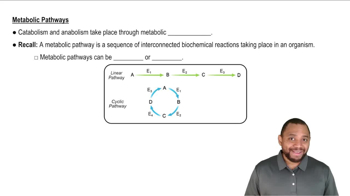
Metabolic Pathways Concept 2