Ch.10 Acids and Bases and Equilibrium
Timberlake - Chemistry: An Introduction to General, Organic, and Biological Chemistry 13th Edition
Timberlake13th EditionChemistry: An Introduction to General, Organic, and Biological ChemistryISBN: 9780134421353Non è quello che usi tu?Cambia libro di testo
Capitolo 10, Problema 28

If a base is added to pure water, why does the [H3O+] decrease?

Guida verificata passo dopo passo
1
Understand that pure water undergoes autoionization, where water molecules react with each other to form hydronium ions (H₃O⁺) and hydroxide ions (OH⁻). This equilibrium is represented as: H(2O)2↔H(3O)+OH−.
Recall that the product of the concentrations of H₃O⁺ and OH⁻ in water is constant at a given temperature, known as the ion product of water, Kw. At 25°C, Kw = 1.0 × 10⁻¹⁴, so [H₃O⁺][OH⁻] = 1.0 × 10⁻¹⁴.
When a base is added to water, it increases the concentration of hydroxide ions (OH⁻) in the solution. This disrupts the equilibrium of the autoionization reaction.
To restore equilibrium, the system shifts according to Le Chatelier's Principle. The increase in OH⁻ concentration causes the reaction to shift to the left, reducing the concentration of H₃O⁺ ions.
As a result, the [H₃O⁺] decreases because the equilibrium adjusts to maintain the constant value of Kw, ensuring that [H₃O⁺][OH⁻] = 1.0 × 10⁻¹⁴ at 25°C.

Risposta video verificata per un problema simile:

Questa soluzione video è stata consigliata dai nostri tutor come utile per risolvere questo problema.
Durata del video:
2m

Concetti chiave

Ecco i concetti essenziali che devi comprendere per rispondere correttamente alla domanda.

Acid-Base Chemistry

Acid-base chemistry involves the study of substances that can donate protons (H⁺ ions) or accept protons. In this context, bases are substances that can accept protons, leading to a decrease in the concentration of hydronium ions (H₃O⁺) in solution. Understanding this concept is crucial for grasping how the addition of a base alters the balance of ions in water.
Video consigliato:
Percorso guidato
03:11
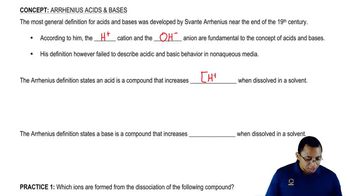
Arrhenius Acids & Bases Concept 1

Equilibrium in Water

Pure water undergoes autoionization, where water molecules dissociate into H⁺ and OH⁻ ions, establishing a dynamic equilibrium. The concentration of H₃O⁺ in pure water is typically 1 x 10⁻⁷ M at 25°C. When a base is added, it shifts this equilibrium, reducing the concentration of H₃O⁺ as the base reacts with available protons.
Video consigliato:
Percorso guidato
03:43
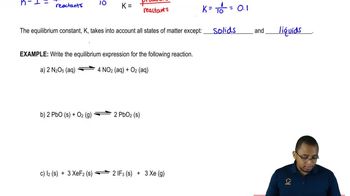
The Equilibrium Constant Example 1

pH Scale

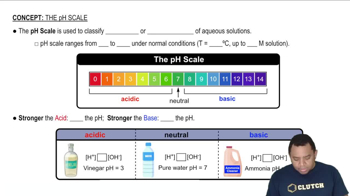
The pH scale measures the acidity or basicity of a solution, with lower values indicating higher acidity (more H₃O⁺) and higher values indicating higher basicity (less H₃O⁺). When a base is introduced to water, the pH increases, reflecting a decrease in H₃O⁺ concentration. Understanding the pH scale is essential for interpreting changes in acidity when a base is added.
Video consigliato: