Ch.10 Acids and Bases and Equilibrium
Timberlake - Chemistry: An Introduction to General, Organic, and Biological Chemistry 13th Edition
Timberlake13th EditionChemistry: An Introduction to General, Organic, and Biological ChemistryISBN: 9780134421353Non è quello che usi tu?Cambia libro di testo
Capitolo 10, Problema 19

What is meant by the term reversible reaction?

Guida verificata passo dopo passo
1
A reversible reaction is a chemical reaction where the reactants can form products, and the products can revert back to reactants under certain conditions.
In a reversible reaction, the forward reaction (reactants forming products) and the reverse reaction (products forming reactants) occur simultaneously.
The reaction reaches a state of dynamic equilibrium when the rate of the forward reaction equals the rate of the reverse reaction, meaning the concentrations of reactants and products remain constant over time.
Reversible reactions are typically represented using a double arrow (⇌) in chemical equations, indicating that both the forward and reverse reactions are possible.
An example of a reversible reaction is the dissociation of acetic acid in water: \( \text{CH}_3\text{COOH} \leftrightarrow \text{CH}_3\text{COO}^- + \text{H}^+ \).

Risposta video verificata per un problema simile:

Questa soluzione video è stata consigliata dai nostri tutor come utile per risolvere questo problema.
Durata del video:
3m

Concetti chiave

Ecco i concetti essenziali che devi comprendere per rispondere correttamente alla domanda.

Reversible Reaction

A reversible reaction is a chemical process where the reactants can be converted into products and, under certain conditions, the products can be converted back into the original reactants. This dynamic equilibrium allows both forward and reverse reactions to occur, depending on factors like concentration, temperature, and pressure.
Video consigliato:
Percorso guidato
06:17
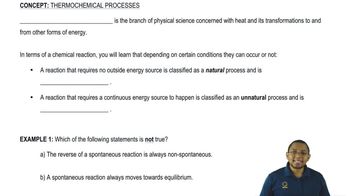
Spontaneous Reaction Concept 1

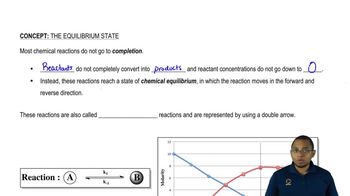
Chemical Equilibrium

Chemical equilibrium is the state in which the rates of the forward and reverse reactions are equal, resulting in constant concentrations of reactants and products over time. At this point, the system is balanced, and no net change occurs, although both reactions continue to take place.
Video consigliato:
Percorso guidato
03:42
Chemical Equilibrium Concept 1

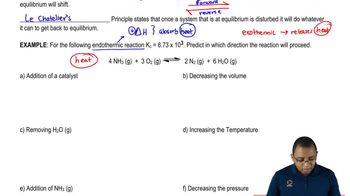
Le Chatelier's Principle

Le Chatelier's Principle states that if a system at equilibrium is subjected to a change in concentration, temperature, or pressure, the system will adjust to counteract that change and restore a new equilibrium. This principle helps predict how a reversible reaction will respond to external changes.
Video consigliato:
Percorso guidato
09:34
The following is an endothermic reaction where Kc = 6.73 x 10³.For each of the choices below predict in which direction the reaction will proceed