Ch.10 Acids and Bases and Equilibrium
Timberlake - Chemistry: An Introduction to General, Organic, and Biological Chemistry 13th Edition
Timberlake13th EditionChemistry: An Introduction to General, Organic, and Biological ChemistryISBN: 9780134421353Non è quello che usi tu?Cambia libro di testo
Capitolo 10, Problema 11a

Write the formula for the conjugate acid for each of the following bases:
a. CO32-

Guida verificata passo dopo passo
1
Identify the base given in the problem. In this case, the base is the carbonate ion, CO₃²⁻.
Recall the definition of a conjugate acid: it is formed when a base accepts a proton (H⁺).
Add one proton (H⁺) to the base, CO₃²⁻. This involves increasing the hydrogen count by 1 and reducing the charge by 1, as the proton carries a positive charge.
Write the resulting formula after adding the proton. The formula becomes HCO₃⁻, which is the conjugate acid of CO₃²⁻.
Verify the result by checking that the conjugate acid has one more hydrogen atom and a charge that is one unit less positive than the original base.

Risposta video verificata per un problema simile:

Questa soluzione video è stata consigliata dai nostri tutor come utile per risolvere questo problema.
Durata del video:
1m

Concetti chiave

Ecco i concetti essenziali che devi comprendere per rispondere correttamente alla domanda.

Conjugate Acid-Base Theory

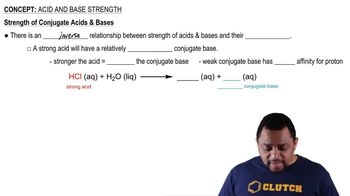
Conjugate acid-base theory, rooted in the Brønsted-Lowry definition, describes acids as proton donors and bases as proton acceptors. When a base accepts a proton (H⁺), it forms its conjugate acid. Understanding this relationship is crucial for predicting the behavior of chemical species in acid-base reactions.
Video consigliato:
Percorso guidato
00:50
Acid and Base Strength Concept 3

Carbonate Ion (CO₃²⁻)

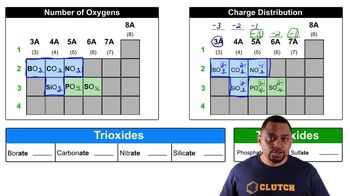
The carbonate ion (CO₃²⁻) is a polyatomic ion consisting of one carbon atom covalently bonded to three oxygen atoms, carrying a -2 charge. It acts as a base in chemical reactions, capable of accepting protons to form its conjugate acid. Recognizing its structure and charge is essential for determining its conjugate acid.
Video consigliato:
Percorso guidato
01:26
Polyatomic Ions

Formation of Conjugate Acids

The formation of a conjugate acid involves the addition of a proton to a base. For the carbonate ion (CO₃²⁻), when it accepts a proton, it transforms into bicarbonate (HCO₃⁻), which is its conjugate acid. This process illustrates the dynamic nature of acid-base chemistry and the importance of understanding proton transfer.
Video consigliato:
Percorso guidato
1:41
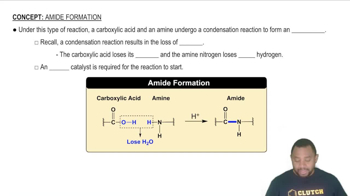
Amide Formation Concept 1