Ch.10 Acids and Bases and Equilibrium
Timberlake - Chemistry: An Introduction to General, Organic, and Biological Chemistry 13th Edition
Timberlake13th EditionChemistry: An Introduction to General, Organic, and Biological ChemistryISBN: 9780134421353Non è quello che usi tu?Cambia libro di testo
Capitolo 10, Problema 15a

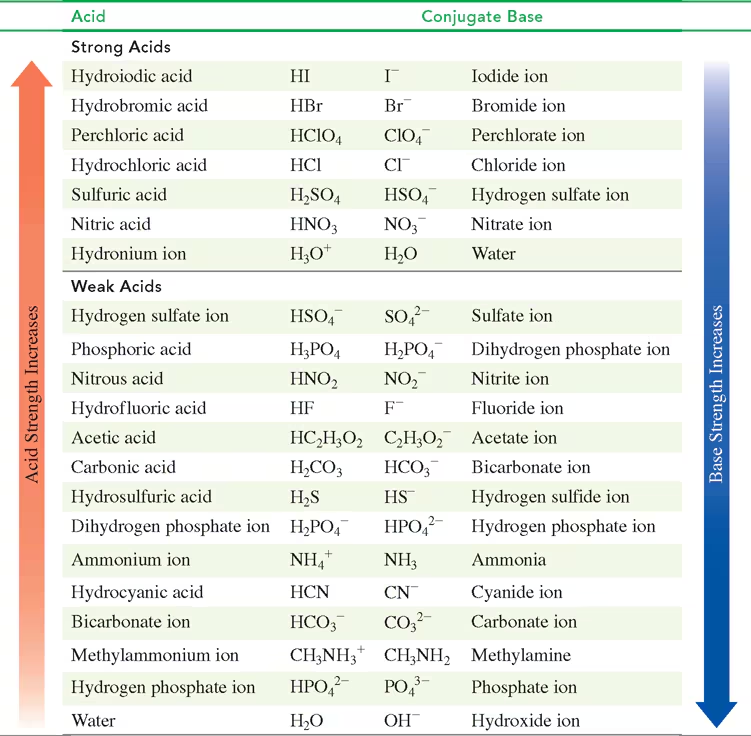
Using TABLE 10.3, identify the stronger acid in each of the following pairs:
Table comparing strong and weak acids with their conjugate bases, highlighting acid strength increases.
a. HBr or HNO2

Guida verificata passo dopo passo
1
Step 1: Review the provided image, which illustrates the increasing acid strength of various acids. The acids are arranged vertically, with stronger acids positioned higher on the arrow labeled 'Increasing Acid Strength.'
Step 2: Locate the acids HBr and HNO₂ on the chart. HBr (hydrobromic acid) is a strong acid and is positioned near the top of the chart, indicating high acid strength. HNO₂ (nitrous acid) is a weaker acid and is positioned lower on the chart.
Step 3: Recall the general rule that strong acids completely dissociate in water, while weaker acids only partially dissociate. HBr is a strong acid, meaning it dissociates completely, whereas HNO₂ is a weak acid, meaning it dissociates partially.
Step 4: Compare the relative positions of HBr and HNO₂ on the chart. Since HBr is higher on the arrow, it is the stronger acid compared to HNO₂.
Step 5: Conclude that HBr is the stronger acid in this pair based on its position on the chart and its complete dissociation behavior.

Risposta video verificata per un problema simile:

Questa soluzione video è stata consigliata dai nostri tutor come utile per risolvere questo problema.
Durata del video:
46s

Concetti chiave

Ecco i concetti essenziali che devi comprendere per rispondere correttamente alla domanda.

Acid Strength

Acid strength refers to the ability of an acid to donate protons (H⁺ ions) in a solution. Stronger acids dissociate more completely in water, resulting in a higher concentration of H⁺ ions. This property is often quantified using the acid dissociation constant (Ka), where a larger Ka indicates a stronger acid. Understanding acid strength is crucial for comparing different acids and predicting their behavior in chemical reactions.
Video consigliato:
Percorso guidato
00:50
Acid and Base Strength Concept 3

Comparative Acid Strength

Comparative acid strength involves evaluating the relative strengths of different acids based on their molecular structure and dissociation behavior. Factors influencing this comparison include electronegativity, bond strength, and the stability of the resulting conjugate base. For example, in the pair HBr and HNO₂, the stronger acid can be identified by analyzing these factors, which are often summarized in tables or graphs that rank acids by their strength.
Video consigliato:
Percorso guidato
00:50
Acid and Base Strength Concept 3

Conjugate Bases

The concept of conjugate bases is integral to understanding acid-base chemistry. When an acid donates a proton, it forms its conjugate base, which can influence the acid's strength. A stable conjugate base corresponds to a stronger acid, as the equilibrium favors the formation of the acid and its conjugate base. In the context of the question, recognizing the stability of the conjugate bases of HBr and HNO₂ will help determine which acid is stronger.
Video consigliato:
Percorso guidato
00:50
Acid and Base Strength Concept 3