Ch.14 Carboxylic Acids, Esters, Amines, and Amides
Timberlake - Chemistry: An Introduction to General, Organic, and Biological Chemistry 13th Edition
Timberlake13th EditionChemistry: An Introduction to General, Organic, and Biological ChemistryISBN: 9780134421353Non è quello che usi tu?Cambia libro di testo
Capitolo 14, Problema 39a

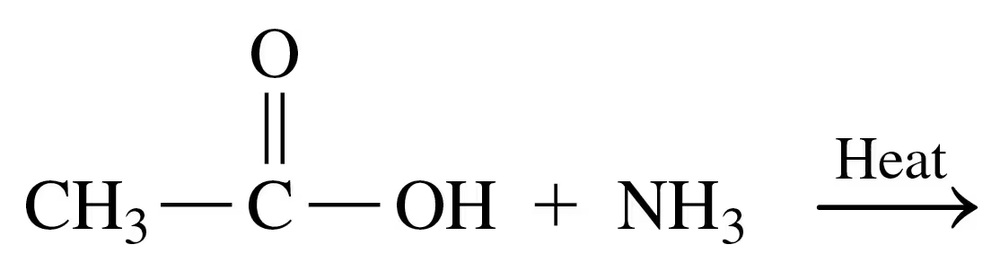
Draw the condensed structural or line-angle formula for the amide formed in each of the following reactions:
a.

Guida verificata passo dopo passo
1
Identify the reactants in the given reaction. In the formation of an amide, the reactants typically include a carboxylic acid (R-COOH) and an amine (R'-NH2 or R'-NHR).
Understand the reaction mechanism: The carboxylic acid reacts with the amine, and during the process, a molecule of water (H2O) is eliminated. This is a condensation reaction.
Determine the structure of the amide: The carbonyl group (C=O) from the carboxylic acid bonds to the nitrogen atom of the amine, forming the amide functional group (-CONH- or -CONR-).
Draw the condensed structural formula: Combine the R group from the carboxylic acid and the R' group from the amine, ensuring the amide functional group is correctly represented in the structure.
If a line-angle formula is required, represent the carbon and hydrogen atoms as lines and vertices, omitting explicit hydrogen atoms bonded to carbons, while clearly showing the amide functional group and any substituents.

Risposta video verificata per un problema simile:

Questa soluzione video è stata consigliata dai nostri tutor come utile per risolvere questo problema.
Durata del video:
1m

Concetti chiave

Ecco i concetti essenziali che devi comprendere per rispondere correttamente alla domanda.

Amides

Amides are organic compounds derived from carboxylic acids where the hydroxyl group is replaced by an amine or ammonia. They have the general structure R-CO-NR'R'', where R represents a hydrocarbon chain, and NR'R'' indicates the nitrogen atom bonded to one or more alkyl or aryl groups. Amides are important in various biological processes and are commonly found in proteins.
Video consigliato:
Percorso guidato
1:03
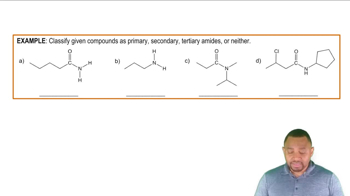
Intro to Amides Example 1

Condensed Structural Formula

A condensed structural formula is a way of representing a chemical structure that shows the arrangement of atoms in a molecule without depicting all the bonds explicitly. It typically groups atoms together to indicate how they are connected, making it easier to visualize the molecular structure. For example, the condensed formula for ethylamine is CH3CH2NH2, which indicates the connectivity of carbon, hydrogen, and nitrogen atoms.
Video consigliato:
Percorso guidato
1:53
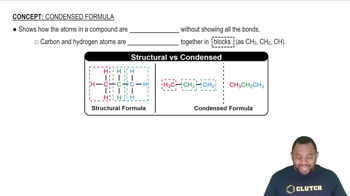
Condensed Formula Concept 1

Line-Angle Formula

The line-angle formula, also known as the skeletal formula, is a simplified way of drawing organic molecules where vertices represent carbon atoms and lines represent bonds. This method omits hydrogen atoms attached to carbons for clarity, making it easier to visualize complex structures. It is particularly useful for depicting larger molecules and functional groups, such as amides, in a clear and concise manner.
Video consigliato:
Percorso guidato
01:24
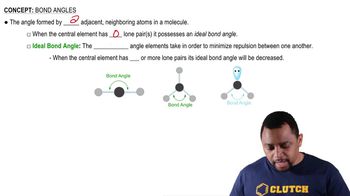
Bond Angles (Simplified) Concept 1