Ch.16 Amino Acids, Proteins, and Enzymes
Timberlake - Chemistry: An Introduction to General, Organic, and Biological Chemistry 13th Edition
Timberlake13th EditionChemistry: An Introduction to General, Organic, and Biological ChemistryISBN: 9780134421353Non è quello che usi tu?Cambia libro di testo
Capitolo 16, Problema 27b

Indicate the changes in secondary and tertiary structural levels of proteins for each of the following:
b. Prior to giving an injection, the skin is wiped with an alcohol swab.

Guida verificata passo dopo passo
1
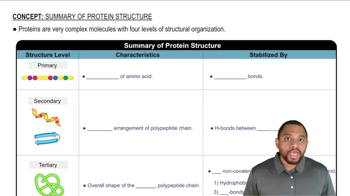
Understand the structural levels of proteins: Proteins have four levels of structure—primary, secondary, tertiary, and quaternary. Secondary structure refers to local folding patterns like alpha-helices and beta-sheets, stabilized by hydrogen bonds. Tertiary structure refers to the overall 3D shape of the protein, stabilized by interactions such as hydrogen bonds, ionic bonds, hydrophobic interactions, and disulfide bridges.
Recognize the effect of alcohol on proteins: Alcohol can disrupt hydrogen bonding and other non-covalent interactions that stabilize the secondary and tertiary structures of proteins. This process is known as denaturation.
Analyze the impact on secondary structure: Alcohol interferes with hydrogen bonds that maintain alpha-helices and beta-sheets, causing these structures to unravel or lose their organized shape.
Analyze the impact on tertiary structure: Alcohol disrupts hydrophobic interactions and ionic bonds, leading to the loss of the protein's 3D shape. Disulfide bridges may remain intact unless exposed to reducing agents.
Conclude the significance: The denaturation of proteins in microorganisms on the skin reduces their functionality, contributing to the antiseptic effect of the alcohol swab prior to injection.

Risposta video verificata per un problema simile:

Questa soluzione video è stata consigliata dai nostri tutor come utile per risolvere questo problema.
Durata del video:
5m

Concetti chiave

Ecco i concetti essenziali che devi comprendere per rispondere correttamente alla domanda.

Protein Structure Levels

Proteins have four levels of structure: primary, secondary, tertiary, and quaternary. The primary structure is the sequence of amino acids, while secondary structure refers to local folding patterns like alpha helices and beta sheets. Tertiary structure is the overall three-dimensional shape of a protein, determined by interactions among various side chains. Understanding these levels is crucial for analyzing how proteins function and how they can be affected by external factors.
Video consigliato:
Percorso guidato
2:56
Summary of Protein Structure Concept 1

Denaturation

Denaturation is the process by which proteins lose their native structure due to external stressors such as heat, pH changes, or chemical agents. This can lead to the unfolding of secondary and tertiary structures, rendering the protein nonfunctional. In the context of wiping skin with an alcohol swab, the alcohol can denature proteins on the skin's surface, which is important for reducing microbial load before an injection.
Video consigliato:
Percorso guidato
1:17
Digestion of Proteins Example 1

Antiseptic Action of Alcohol

Alcohol, particularly isopropyl or ethyl alcohol, is commonly used as an antiseptic due to its ability to denature proteins and disrupt cell membranes of microorganisms. This action effectively reduces the number of pathogens on the skin, minimizing the risk of infection during injections. Understanding the mechanism of alcohol's antiseptic properties helps explain its role in medical procedures.
Video consigliato:
Percorso guidato
2:39
Models of Enzyme Action Concept 1