Ch.16 Amino Acids, Proteins, and Enzymes
Timberlake - Chemistry: An Introduction to General, Organic, and Biological Chemistry 13th Edition
Timberlake13th EditionChemistry: An Introduction to General, Organic, and Biological ChemistryISBN: 9780134421353Non è quello che usi tu?Cambia libro di testo
Capitolo 16, Problema 26b

Indicate whether each of the following statements describes primary, secondary, tertiary, or quaternary protein structure:
b. Protein chains of collagen form a triple helix.

Guida verificata passo dopo passo
1
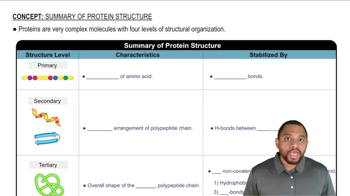
Understand the four levels of protein structure: Primary structure refers to the sequence of amino acids in a polypeptide chain. Secondary structure involves local folding patterns such as alpha helices and beta sheets. Tertiary structure describes the overall 3D shape of a single polypeptide chain. Quaternary structure refers to the arrangement of multiple polypeptide chains or subunits in a protein.
Analyze the statement: 'Protein chains of collagen form a triple helix.' This indicates that multiple polypeptide chains are interacting to form a specific structure.
Recognize that the triple helix is formed by the interaction of three polypeptide chains, which is characteristic of quaternary protein structure.
Recall that quaternary structure is unique to proteins with more than one polypeptide chain, and it describes how these chains are arranged and interact.
Conclude that the statement describes quaternary protein structure because it involves the arrangement of multiple polypeptide chains forming a triple helix.

Risposta video verificata per un problema simile:

Questa soluzione video è stata consigliata dai nostri tutor come utile per risolvere questo problema.
Durata del video:
4m

Concetti chiave

Ecco i concetti essenziali che devi comprendere per rispondere correttamente alla domanda.

Protein Structure Levels

Proteins have four levels of structure: primary, secondary, tertiary, and quaternary. Primary structure refers to the linear sequence of amino acids, secondary structure involves local folding patterns like alpha helices and beta sheets, tertiary structure is the overall 3D shape of a single polypeptide, and quaternary structure describes the assembly of multiple polypeptide chains into a functional protein.
Video consigliato:
Percorso guidato
2:56
Summary of Protein Structure Concept 1

Collagen Structure

Collagen is a structural protein that primarily provides strength and support in connective tissues. Its unique triple helix formation is a type of secondary structure, where three polypeptide chains intertwine, contributing to its tensile strength and stability. This arrangement is crucial for the function of collagen in various biological contexts.
Video consigliato:
Percorso guidato
1:01
Structural Formula Concept 2

Helical Structures in Proteins

Helical structures, such as the triple helix found in collagen, are a common feature in protein secondary structures. These helices are stabilized by hydrogen bonds between the backbone of the polypeptide chains. Understanding these helical formations is essential for grasping how proteins maintain their structural integrity and perform their biological functions.
Video consigliato:
Percorso guidato
2:07
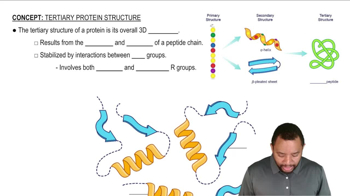
Tertiary Protein Structure Concept 1