Ch.16 Amino Acids, Proteins, and Enzymes
Timberlake - Chemistry: An Introduction to General, Organic, and Biological Chemistry 13th Edition
Timberlake13th EditionChemistry: An Introduction to General, Organic, and Biological ChemistryISBN: 9780134421353Non è quello che usi tu?Cambia libro di testo
Capitolo 16, Problema 35a

Match the terms (1) enzyme–substrate complex, (2) enzyme, and (3) substrate with each of the following:
a. has a tertiary structure that recognizes the substrate

Guida verificata passo dopo passo
1
Understand the definitions of the terms: (1) enzyme–substrate complex, (2) enzyme, and (3) substrate. An enzyme is a protein that catalyzes chemical reactions, a substrate is the molecule upon which the enzyme acts, and the enzyme–substrate complex is the temporary structure formed when the enzyme binds to the substrate.
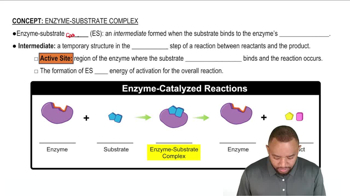
Recall that enzymes have a specific tertiary structure, which is the three-dimensional folding of the protein. This structure includes an active site that is specifically shaped to recognize and bind to the substrate.
Identify that the term 'enzyme' corresponds to the description 'has a tertiary structure that recognizes the substrate,' because the enzyme's active site is responsible for this recognition.
Understand that the substrate is the molecule that fits into the enzyme's active site, and the enzyme–substrate complex is formed when the enzyme and substrate are bound together during the reaction.
Match the description 'has a tertiary structure that recognizes the substrate' with the term 'enzyme,' as it is the enzyme's structure that facilitates substrate recognition.

Risposta video verificata per un problema simile:

Questa soluzione video è stata consigliata dai nostri tutor come utile per risolvere questo problema.
Durata del video:
1m

Concetti chiave

Ecco i concetti essenziali che devi comprendere per rispondere correttamente alla domanda.

Enzyme

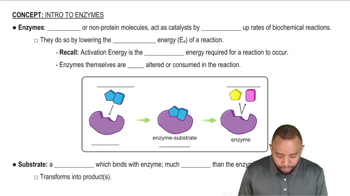
An enzyme is a biological catalyst that accelerates chemical reactions in living organisms. It is typically a protein with a specific three-dimensional structure that allows it to bind to a particular substrate. The enzyme's active site is designed to recognize and interact with the substrate, facilitating the conversion of reactants into products.
Video consigliato:
Percorso guidato
2:14
Intro to Enzymes Concept 1

Substrate

A substrate is a molecule upon which an enzyme acts. It is the reactant that is transformed during the enzymatic reaction. The specificity of an enzyme for its substrate is determined by the shape and chemical properties of both the enzyme's active site and the substrate, ensuring that only specific substrates can bind and undergo a reaction.
Video consigliato:
Percorso guidato
2:32
Enzyme-Substrate Complex Concept 1

Enzyme-Substrate Complex

The enzyme-substrate complex is a temporary molecular structure formed when an enzyme binds to its substrate. This complex is crucial for the catalytic process, as it stabilizes the transition state and lowers the activation energy required for the reaction to proceed. The formation of this complex is essential for the enzyme to effectively convert the substrate into products.
Video consigliato:
Percorso guidato
2:32
Enzyme-Substrate Complex Concept 1