Ch.17 Nucleic Acids and Protein Synthesis
Timberlake - Chemistry: An Introduction to General, Organic, and Biological Chemistry 13th Edition
Timberlake13th EditionChemistry: An Introduction to General, Organic, and Biological ChemistryISBN: 9780134421353Non è quello che usi tu?Cambia libro di testo
Capitolo 17, Problema 7d

Identify each of the following as a nucleoside or a nucleotide:
d. cytidine monophosphate

Guida verificata passo dopo passo
1
Step 1: Understand the difference between a nucleoside and a nucleotide. A nucleoside consists of a nitrogenous base (like cytosine, adenine, guanine, thymine, or uracil) attached to a sugar (ribose or deoxyribose). A nucleotide, on the other hand, is a nucleoside with one or more phosphate groups attached to the sugar.
Step 2: Analyze the given name, 'cytidine monophosphate.' The term 'cytidine' indicates that the molecule contains the nitrogenous base cytosine attached to a sugar (ribose). The term 'monophosphate' indicates that there is one phosphate group attached.
Step 3: Combine the information. Since the molecule contains a nitrogenous base (cytosine), a sugar (ribose), and a phosphate group, it fits the definition of a nucleotide.
Step 4: Confirm the structure. Cytidine monophosphate specifically refers to a nucleotide where cytosine is bonded to ribose, and a single phosphate group is attached to the 5' carbon of the ribose.
Step 5: Conclude that cytidine monophosphate is a nucleotide because it contains all three components: a nitrogenous base, a sugar, and a phosphate group.

Risposta video verificata per un problema simile:

Questa soluzione video è stata consigliata dai nostri tutor come utile per risolvere questo problema.
Durata del video:
57s

Concetti chiave

Ecco i concetti essenziali che devi comprendere per rispondere correttamente alla domanda.

Nucleoside

A nucleoside consists of a nitrogenous base (adenine, guanine, cytosine, or thymine) attached to a sugar molecule (ribose or deoxyribose). It does not contain any phosphate groups. Nucleosides are the building blocks of nucleotides and play a crucial role in the structure of nucleic acids.
Video consigliato:
Percorso guidato
1:21
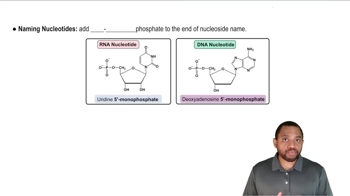
Naming Nucleosides and Nucleotides Concept 2

Nucleotide

A nucleotide is a more complex molecule that includes a nitrogenous base, a sugar, and one or more phosphate groups. Nucleotides are the basic units of nucleic acids like DNA and RNA, and they are essential for various biological processes, including energy transfer and signaling.
Video consigliato:
Percorso guidato
1:21
Naming Nucleosides and Nucleotides Concept 2

Cytidine Monophosphate (CMP)

Cytidine monophosphate (CMP) is a specific type of nucleotide that consists of the nitrogenous base cytosine, the sugar ribose, and a single phosphate group. It is involved in the synthesis of RNA and plays a role in cellular metabolism and signaling pathways.
Video consigliato:
Percorso guidato
1:21
Naming Nucleosides and Nucleotides Concept 2