Ch.17 Nucleic Acids and Protein Synthesis
Timberlake - Chemistry: An Introduction to General, Organic, and Biological Chemistry 13th Edition
Timberlake13th EditionChemistry: An Introduction to General, Organic, and Biological ChemistryISBN: 9780134421353Non è quello che usi tu?Cambia libro di testo
Capitolo 17, Problema 1b

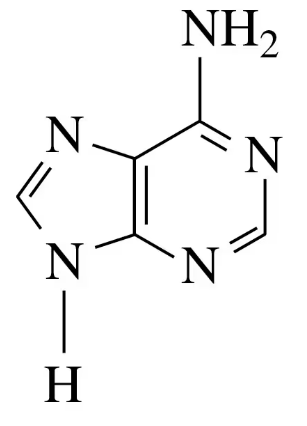
Identify each of the following bases as a purine or a pyrimidine:
b. Chemical structure of adenine, a purine nitrogenous base, showing its molecular components and arrangement.

Guida verificata passo dopo passo
1
Understand the difference between purines and pyrimidines: Purines are larger, double-ring structures, while pyrimidines are smaller, single-ring structures. Examples of purines include adenine (A) and guanine (G), while pyrimidines include cytosine (C), thymine (T), and uracil (U).
Examine the structure of the base provided in the image. Look for the number of rings in the structure: a single ring indicates a pyrimidine, while two fused rings indicate a purine.
Identify any functional groups or atoms attached to the rings. For example, purines often have amine groups or oxygen atoms attached to their double-ring structure, while pyrimidines may have similar groups attached to their single ring.
Compare the structure in the image to known examples of purines and pyrimidines to determine its classification.
Conclude whether the base in the image is a purine or a pyrimidine based on its structural characteristics and the number of rings.

Risposta video verificata per un problema simile:

Questa soluzione video è stata consigliata dai nostri tutor come utile per risolvere questo problema.
Durata del video:
2m

Concetti chiave

Ecco i concetti essenziali che devi comprendere per rispondere correttamente alla domanda.

Purines

Purines are one of the two classes of nitrogenous bases found in nucleic acids, characterized by a double-ring structure. The two primary purines in DNA and RNA are adenine (A) and guanine (G). Their structure allows them to form hydrogen bonds with complementary pyrimidines, playing a crucial role in the formation of the DNA double helix and RNA structures.
Video consigliato:
Percorso guidato
1:09
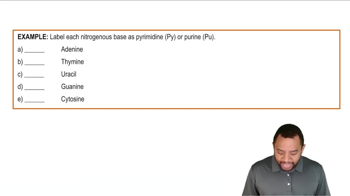
Nitrogenous Bases Example 1

Pyrimidines

Pyrimidines are the second class of nitrogenous bases, distinguished by a single-ring structure. The main pyrimidines in nucleic acids are cytosine (C), thymine (T), and uracil (U). These bases pair with purines to stabilize the nucleic acid structure, contributing to the genetic code and the overall function of DNA and RNA.
Video consigliato:
Percorso guidato
1:09
Nitrogenous Bases Example 1

Base Pairing

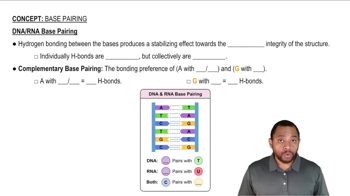
Base pairing refers to the specific hydrogen bonding between purines and pyrimidines in nucleic acids, which is essential for the stability and integrity of DNA and RNA. In DNA, adenine pairs with thymine, while guanine pairs with cytosine. In RNA, adenine pairs with uracil instead of thymine. This complementary pairing is fundamental for processes such as DNA replication and transcription.
Video consigliato:
Percorso guidato
2:56
Base Pairing Concept 1