Ch.18 Metabolic Pathways and ATP Production
Timberlake - Chemistry: An Introduction to General, Organic, and Biological Chemistry 13th Edition
Timberlake13th EditionChemistry: An Introduction to General, Organic, and Biological ChemistryISBN: 9780134421353Non è quello che usi tu?Cambia libro di testo
Capitolo 18, Problema 72

Draw the condensed structural formulas for the products of the reaction of aspartate and α-ketoglutarate which is catalyzed by aspartate transaminase (AST).

Guida verificata passo dopo passo
1
Understand the reaction: Aspartate transaminase (AST) catalyzes a transamination reaction where an amino group is transferred from aspartate to α-ketoglutarate, forming oxaloacetate and glutamate as products.
Identify the reactants: Aspartate is an amino acid with the structure NH₂-CH(COOH)-CH₂-COOH, and α-ketoglutarate is a keto acid with the structure CO-CH₂-CH₂-COOH.
Determine the products: In the reaction, the amino group from aspartate is transferred to α-ketoglutarate, converting aspartate into oxaloacetate (CO-CH₂-COOH) and α-ketoglutarate into glutamate (NH₂-CH(COOH)-CH₂-CH₂-COOH).
Draw the condensed structural formula for oxaloacetate: Oxaloacetate is a keto acid with the structure CO-CH₂-COOH. Represent this in condensed form as CH₂(CO)-COOH.
Draw the condensed structural formula for glutamate: Glutamate is an amino acid with the structure NH₂-CH(COOH)-CH₂-CH₂-COOH. Represent this in condensed form as NH₂-CH(COOH)-CH₂-CH₂-COOH.

Risposta video verificata per un problema simile:

Questa soluzione video è stata consigliata dai nostri tutor come utile per risolvere questo problema.
Durata del video:
5m

Concetti chiave

Ecco i concetti essenziali che devi comprendere per rispondere correttamente alla domanda.

Transamination

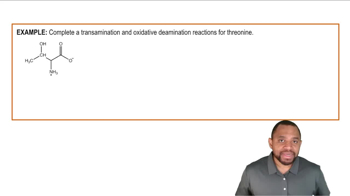
Transamination is a biochemical process where an amino group from an amino acid is transferred to a keto acid, forming a new amino acid and a new keto acid. This reaction is crucial in amino acid metabolism and is catalyzed by enzymes known as transaminases or aminotransferases. In the context of the question, aspartate transaminase (AST) facilitates the conversion of aspartate and α-ketoglutarate.
Video consigliato:
Percorso guidato
3:03
Amino Acid Catabolism: Amino Group Example 2

Aspartate

Aspartate is a non-essential amino acid that plays a key role in the urea cycle and in the synthesis of other amino acids. It contains an amino group, a carboxyl group, and a side chain that contributes to its properties. In the transamination reaction, aspartate donates its amino group to α-ketoglutarate, resulting in the formation of oxaloacetate.
Video consigliato:
Percorso guidato
2:00
Secondary Protein Structure Example 1

α-Ketoglutarate

α-Ketoglutarate is a key intermediate in the Krebs cycle (citric acid cycle) and serves as a keto acid in transamination reactions. It is formed from the deamination of glutamate and can accept an amino group to form glutamate. In the reaction with aspartate, α-ketoglutarate is converted into glutamate, illustrating the interconnectedness of amino acid metabolism and energy production.
Video consigliato:
Percorso guidato
1:33
Review of Metabolism Example 1