Ch.18 Metabolic Pathways and ATP Production
Timberlake - Chemistry: An Introduction to General, Organic, and Biological Chemistry 13th Edition
Timberlake13th EditionChemistry: An Introduction to General, Organic, and Biological ChemistryISBN: 9780134421353Non è quello che usi tu?Cambia libro di testo
Capitolo 18, Problema 21

How is ATP used in the initial steps of glycolysis?

Guida verificata passo dopo passo
1
Understand that glycolysis is the metabolic pathway that breaks down glucose into pyruvate, producing energy in the form of ATP and NADH. The initial steps of glycolysis are energy-investment steps where ATP is consumed to prepare glucose for further breakdown.
In the first step of glycolysis, ATP is used to phosphorylate glucose. This reaction is catalyzed by the enzyme hexokinase, and the product is glucose-6-phosphate. The reaction can be represented as: ATP + glucose6 → glucose6phosphate + ADP.
In the third step of glycolysis, another ATP molecule is used. The enzyme phosphofructokinase catalyzes the phosphorylation of fructose-6-phosphate to form fructose-1,6-bisphosphate. This reaction can be represented as: ATP + fructose6phosphate → fructose1,6bisphosphate + ADP.
Recognize that the phosphorylation of glucose and fructose-6-phosphate by ATP makes these molecules more reactive and traps them inside the cell, as phosphorylated sugars cannot easily cross the cell membrane.
Summarize that ATP is used in the initial steps of glycolysis to invest energy, enabling the glucose molecule to be primed for subsequent breakdown and energy extraction in later steps of the pathway.

Risposta video verificata per un problema simile:

Questa soluzione video è stata consigliata dai nostri tutor come utile per risolvere questo problema.
Durata del video:
1m

Concetti chiave

Ecco i concetti essenziali che devi comprendere per rispondere correttamente alla domanda.

Adenosine Triphosphate (ATP)

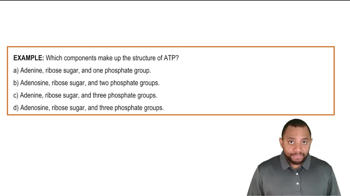
ATP is the primary energy carrier in all living organisms. It consists of adenine, ribose, and three phosphate groups. The energy stored in the high-energy bonds between the phosphate groups is released when ATP is hydrolyzed to ADP and inorganic phosphate, making it essential for various cellular processes, including glycolysis.
Video consigliato:
Percorso guidato
1:03
Adenosine Triphosphate (ATP) Example 2

Glycolysis

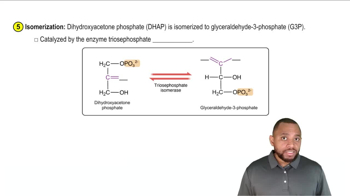
Glycolysis is a metabolic pathway that converts glucose into pyruvate, producing a small amount of ATP and NADH in the process. It occurs in the cytoplasm and consists of ten enzymatic reactions, divided into two phases: the energy investment phase and the energy payoff phase. The initial steps of glycolysis require ATP to phosphorylate glucose and its derivatives, facilitating subsequent reactions.
Video consigliato:
Percorso guidato
1:26
Glycolysis Concept 5

Phosphorylation

Phosphorylation is the addition of a phosphate group to a molecule, which often alters the molecule's activity or function. In glycolysis, the phosphorylation of glucose to glucose-6-phosphate is a crucial step that traps glucose in the cell and prepares it for further breakdown. This process is catalyzed by the enzyme hexokinase and is vital for the regulation of glucose metabolism.
Video consigliato:
Percorso guidato
0:51
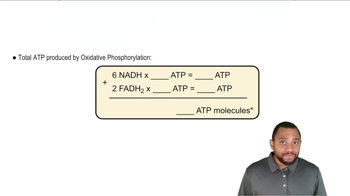
Oxidative Phosphorylation Concept 2