Ch.18 Metabolic Pathways and ATP Production
Timberlake - Chemistry: An Introduction to General, Organic, and Biological Chemistry 13th Edition
Timberlake13th EditionChemistry: An Introduction to General, Organic, and Biological ChemistryISBN: 9780134421353Non è quello che usi tu?Cambia libro di testo
Capitolo 18, Problema 28c

How many ATP or NADH are produced (or required) in each of the following steps in glycolysis?
c. phosphoenolpyruvate to pyruvate

Guida verificata passo dopo passo
1
Step 1: Understand the context of the reaction. The conversion of phosphoenolpyruvate (PEP) to pyruvate is the final step in glycolysis, catalyzed by the enzyme pyruvate kinase.
Step 2: Recall that this step is a substrate-level phosphorylation reaction. During this process, a phosphate group from phosphoenolpyruvate is transferred to ADP to form ATP.
Step 3: Write the chemical equation for the reaction: phosphoenolpyruvate + ADP + H+ → pyruvate + ATP.
Step 4: Note that for each molecule of phosphoenolpyruvate converted to pyruvate, one molecule of ATP is produced. This is a net gain of ATP in glycolysis.
Step 5: Summarize the result: The conversion of phosphoenolpyruvate to pyruvate produces 1 ATP per molecule of phosphoenolpyruvate.

Risposta video verificata per un problema simile:

Questa soluzione video è stata consigliata dai nostri tutor come utile per risolvere questo problema.
Durata del video:
2m

Concetti chiave

Ecco i concetti essenziali che devi comprendere per rispondere correttamente alla domanda.

Glycolysis

Glycolysis is a metabolic pathway that converts glucose into pyruvate, producing energy in the form of ATP and NADH. It occurs in the cytoplasm of cells and consists of ten enzymatic reactions, divided into two phases: the energy investment phase and the energy payoff phase. Understanding glycolysis is essential for analyzing energy production in cellular respiration.
Video consigliato:
Percorso guidato
1:26
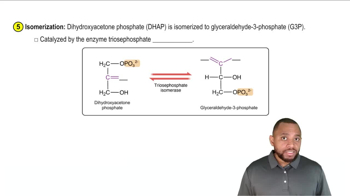
Glycolysis Concept 5

Phosphoenolpyruvate (PEP)

Phosphoenolpyruvate (PEP) is a high-energy intermediate in glycolysis, formed from 2-phosphoglycerate. It plays a crucial role in the final step of glycolysis, where it is converted to pyruvate by the enzyme pyruvate kinase. This reaction is significant because it generates ATP through substrate-level phosphorylation, contributing to the overall energy yield of glycolysis.
Video consigliato:
Percorso guidato
1:31
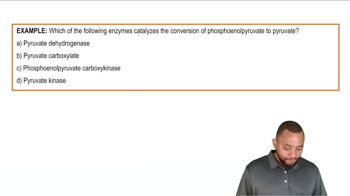
Glycolysis Example 4

ATP and NADH Production

During glycolysis, ATP and NADH are produced through various reactions. Specifically, the conversion of phosphoenolpyruvate to pyruvate generates one ATP molecule via substrate-level phosphorylation. Additionally, glycolysis produces two NADH molecules per glucose molecule, which are crucial for further energy production in aerobic respiration.
Video consigliato:
Percorso guidato
2:20
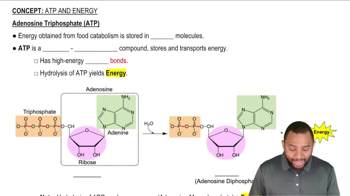
Adenosine Triphosphate (ATP) Concept 2