Ch.6 Ionic and Molecular Compounds
Timberlake - Chemistry: An Introduction to General, Organic, and Biological Chemistry 13th Edition
Timberlake13th EditionChemistry: An Introduction to General, Organic, and Biological ChemistryISBN: 9780134421353Non è quello che usi tu?Cambia libro di testo
Capitolo 6, Problema 135b

Calculate the electronegativity difference and classify each of the following bonds as nonpolar covalent, polar covalent, or ionic:
b. C and C

Guida verificata passo dopo passo
1
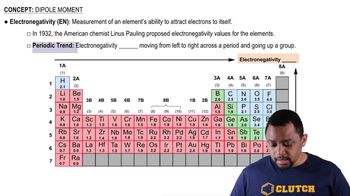
Determine the electronegativity values for both atoms involved in the bond. For carbon (C), the electronegativity is approximately 2.55.
Calculate the electronegativity difference by subtracting the smaller electronegativity value from the larger one. Since both atoms are carbon, the difference is |2.55 - 2.55| = 0.
Interpret the electronegativity difference: If the difference is 0, the bond is classified as a nonpolar covalent bond because the electrons are shared equally between the two atoms.
Conclude that the bond between two carbon atoms (C and C) is a nonpolar covalent bond due to the identical electronegativity values.
Remember that nonpolar covalent bonds occur when the electronegativity difference is less than 0.4, polar covalent bonds occur when the difference is between 0.4 and 1.7, and ionic bonds occur when the difference is greater than 1.7.

Risposta video verificata per un problema simile:

Questa soluzione video è stata consigliata dai nostri tutor come utile per risolvere questo problema.
Durata del video:
1m

Concetti chiave

Ecco i concetti essenziali che devi comprendere per rispondere correttamente alla domanda.

Electronegativity

Electronegativity is a measure of an atom's ability to attract and hold onto electrons in a chemical bond. It is a key factor in determining the nature of bonds between atoms. The higher the electronegativity value, the stronger the atom's pull on electrons. This concept is essential for classifying bonds as nonpolar covalent, polar covalent, or ionic based on the difference in electronegativity between the bonded atoms.
Video consigliato:
Percorso guidato
01:51
Dipole Moment (Simplified) Concept 1

Bond Classification

Bonds can be classified into three main types based on electronegativity differences: nonpolar covalent bonds occur when the difference is less than 0.4, polar covalent bonds when the difference is between 0.4 and 1.7, and ionic bonds when the difference is greater than 1.7. This classification helps predict the properties of substances, such as solubility and conductivity, based on the nature of the bonds formed.
Video consigliato:
Percorso guidato
04:19
Classification of Matter

C-C Bond Characteristics

A bond between two carbon atoms (C-C) is a classic example of a nonpolar covalent bond. Since both atoms have the same electronegativity, they share electrons equally, resulting in no charge separation. Understanding this characteristic is crucial for analyzing molecular structures and predicting the behavior of organic compounds in various chemical reactions.
Video consigliato:
Percorso guidato
1:21
Phase C - Oxaloacetate Regeneration Example 3