Ch.6 Ionic and Molecular Compounds
Timberlake - Chemistry: An Introduction to General, Organic, and Biological Chemistry 13th Edition
Timberlake13th EditionChemistry: An Introduction to General, Organic, and Biological ChemistryISBN: 9780134421353Non è quello che usi tu?Cambia libro di testo
Capitolo 6, Problema 141a

Predict the shape and polarity of each of the following molecules, which have polar covalent bonds:
a. A central atom with three identical bonded atoms and one lone pair.

Guida verificata passo dopo passo
1
Determine the electron group geometry around the central atom. Since there are three bonded atoms and one lone pair, the total number of electron groups is 4. This corresponds to a tetrahedral electron group geometry.
Identify the molecular shape. With one lone pair and three bonded atoms, the molecular shape is trigonal pyramidal. Lone pairs repel bonded atoms more strongly, causing the bonded atoms to be pushed closer together.
Assess the bond polarity. Since the bonds are described as polar covalent, the bonded atoms have different electronegativities, resulting in partial charges on the bonds.
Evaluate the overall molecular polarity. Due to the asymmetrical shape (trigonal pyramidal), the dipole moments of the polar bonds do not cancel out, making the molecule polar.
Summarize: The molecule has a trigonal pyramidal shape and is polar due to its asymmetrical geometry and the presence of polar covalent bonds.

Risposta video verificata per un problema simile:

Questa soluzione video è stata consigliata dai nostri tutor come utile per risolvere questo problema.
Durata del video:
5m

Concetti chiave

Ecco i concetti essenziali che devi comprendere per rispondere correttamente alla domanda.

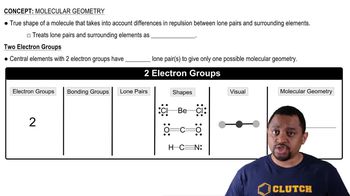
Molecular Geometry

Molecular geometry refers to the three-dimensional arrangement of atoms in a molecule. It is determined by the number of bonding pairs and lone pairs of electrons around the central atom, which influences the shape of the molecule. For example, a central atom with three identical bonded atoms and one lone pair adopts a trigonal pyramidal shape due to the repulsion between the lone pair and the bonded atoms.
Video consigliato:
Percorso guidato
01:30
Molecular Geometry (Simplified) Concept 1

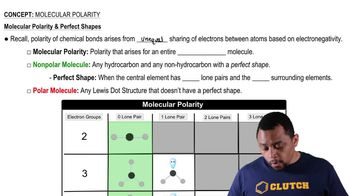
Polarity of Molecules

Polarity in molecules arises from the distribution of electrical charge, which is influenced by the presence of polar covalent bonds. A molecule is considered polar if it has a net dipole moment, resulting from an uneven distribution of electron density. In the case of a trigonal pyramidal molecule, the lone pair creates an area of negative charge, leading to a polar molecule with a distinct positive and negative end.
Video consigliato:
Percorso guidato
01:34
Molecular Polarity (Simplified) Concept 1

VSEPR Theory

Valence Shell Electron Pair Repulsion (VSEPR) theory is a model used to predict the geometry of molecules based on the repulsion between electron pairs surrounding a central atom. According to VSEPR, electron pairs, whether bonding or lone pairs, will arrange themselves to minimize repulsion, thus determining the molecular shape. This theory helps explain why a central atom with three bonded atoms and one lone pair forms a trigonal pyramidal shape.
Video consigliato: