Ch.6 Ionic and Molecular Compounds
Timberlake - Chemistry: An Introduction to General, Organic, and Biological Chemistry 13th Edition
Timberlake13th EditionChemistry: An Introduction to General, Organic, and Biological ChemistryISBN: 9780134421353Non è quello che usi tu?Cambia libro di testo
Capitolo 6, Problema 112c

Consider an ion with the symbol Y3- formed from a representative element.
c. If Y is in Period 3, what is the element?

Guida verificata passo dopo passo
1
Identify the charge of the ion, which is 3⁻. This indicates that the element has gained 3 electrons to form the ion.
Determine the number of valence electrons in the neutral atom of the element. Since the ion has gained 3 electrons, the neutral atom must have had 5 valence electrons to reach a full octet (8 valence electrons).
Locate the group in the periodic table that corresponds to 5 valence electrons. Elements with 5 valence electrons are in Group 15 (or Group 5A in older notation).
Focus on Period 3 of the periodic table, as the problem specifies that the element is in Period 3. The element in Group 15 and Period 3 is phosphorus (P).
Conclude that the element Y is phosphorus (P), and the ion Y³⁻ corresponds to the phosphide ion (P³⁻).

Risposta video verificata per un problema simile:

Questa soluzione video è stata consigliata dai nostri tutor come utile per risolvere questo problema.
Durata del video:
3m

Concetti chiave

Ecco i concetti essenziali che devi comprendere per rispondere correttamente alla domanda.

Ion Formation

Ions are charged particles that form when atoms gain or lose electrons. A cation has a positive charge due to the loss of electrons, while an anion has a negative charge from gaining electrons. In this case, Y³⁻ indicates that the element has gained three electrons, resulting in a negative charge.
Video consigliato:
Percorso guidato
1:41
Amide Formation Concept 1

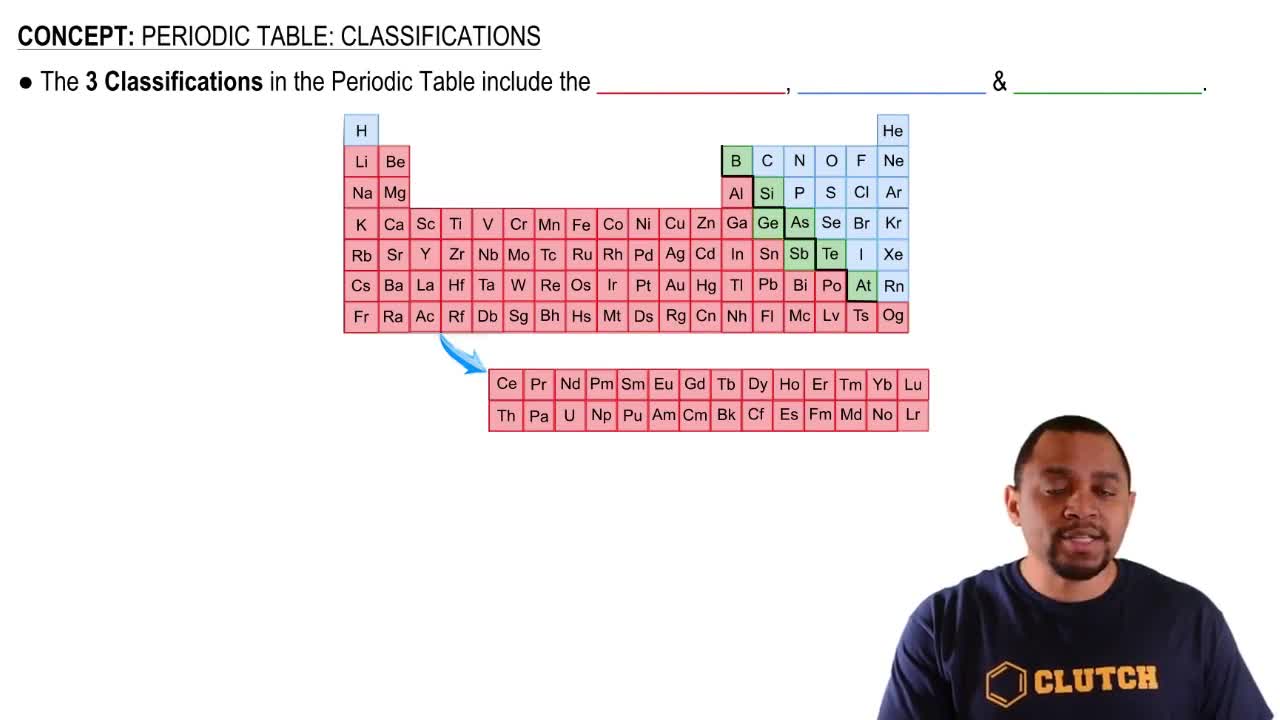
Periodic Table and Periods

The periodic table organizes elements based on their atomic number and properties. Each horizontal row is called a period, and elements in the same period share similar energy levels. Period 3 includes elements such as sodium, magnesium, and sulfur, which are crucial for identifying the element Y.
Video consigliato:
Percorso guidato
02:40
Periodic Table: Classifications

Representative Elements

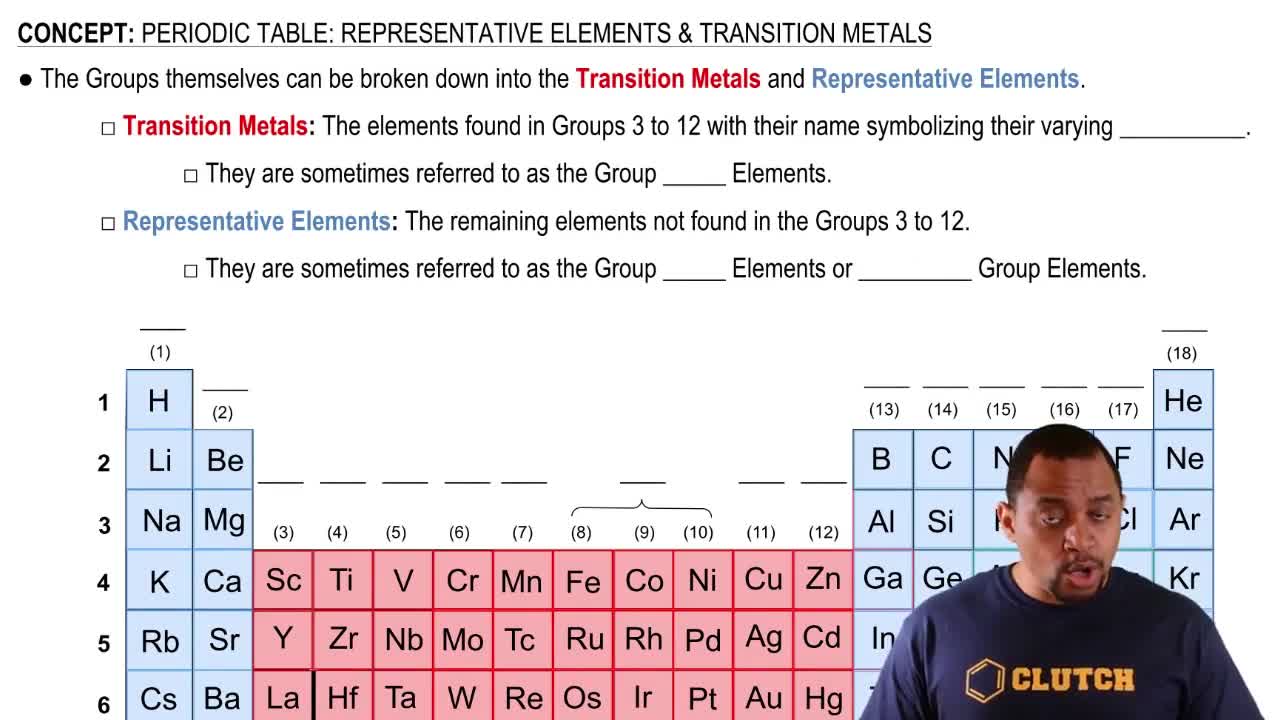
Representative elements, also known as main group elements, are found in groups 1, 2, and 13-18 of the periodic table. They exhibit a wide range of chemical and physical properties and typically form predictable ions. Understanding that Y is a representative element helps narrow down the possibilities for its identity in Period 3.
Video consigliato:
Percorso guidato
03:30
Periodic Table: Representative Elements & Transition Metals