Ch.6 Ionic and Molecular Compounds
Timberlake - Chemistry: An Introduction to General, Organic, and Biological Chemistry 13th Edition
Timberlake13th EditionChemistry: An Introduction to General, Organic, and Biological ChemistryISBN: 9780134421353Non è quello che usi tu?Cambia libro di testo
Capitolo 6, Problema 127b

Draw the Lewis structure for each of the following:
b. H2NOH (N is the central atom)

Guida verificata passo dopo passo
1
Step 1: Count the total number of valence electrons in the molecule. Hydrogen (H) has 1 valence electron, nitrogen (N) has 5 valence electrons, and oxygen (O) has 6 valence electrons. Add these together, considering there are two hydrogens in the molecule.
Step 2: Identify the central atom. In this case, nitrogen (N) is the central atom because it is less electronegative than oxygen and can form multiple bonds.
Step 3: Connect the atoms with single bonds. Place nitrogen (N) in the center, and connect it to one hydrogen (H), one oxygen (O), and the hydroxyl group (-OH). Each single bond represents 2 electrons.
Step 4: Distribute the remaining valence electrons to satisfy the octet rule for the oxygen atom first, then the nitrogen atom. Hydrogen atoms only need 2 electrons to complete their valence shell.
Step 5: Check the structure to ensure all atoms have the correct number of electrons. Adjust the placement of lone pairs or bonds if necessary to satisfy the octet rule for nitrogen and oxygen, while ensuring the total number of electrons matches the count from Step 1.

Risposta video verificata per un problema simile:

Questa soluzione video è stata consigliata dai nostri tutor come utile per risolvere questo problema.
Durata del video:
5m

Concetti chiave

Ecco i concetti essenziali che devi comprendere per rispondere correttamente alla domanda.

Lewis Structure

A Lewis structure is a diagram that represents the bonding between atoms in a molecule and the lone pairs of electrons that may exist. It uses dots to represent electrons and lines to represent bonds between atoms. Understanding how to draw Lewis structures is essential for visualizing molecular geometry and predicting the behavior of molecules in chemical reactions.
Video consigliato:
Percorso guidato
03:11
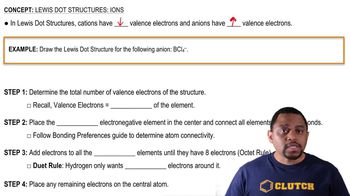
Lewis Dot Structures: Ions (Simplified) Concept 1

Valence Electrons

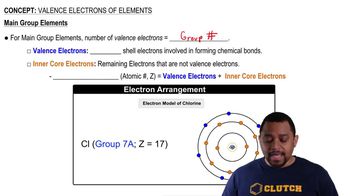
Valence electrons are the outermost electrons of an atom and are crucial in determining how atoms bond with each other. The number of valence electrons influences the atom's ability to form bonds, either by sharing or transferring electrons. For the molecule H₂NOH, knowing the valence electrons of hydrogen, nitrogen, and oxygen is necessary to accurately construct its Lewis structure.
Video consigliato:
Percorso guidato
01:55
Valence Electrons of Elements (Simplified) Concept 1

Molecular Geometry

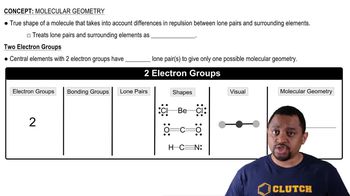
Molecular geometry refers to the three-dimensional arrangement of atoms within a molecule. It is influenced by the number of bonds and lone pairs around the central atom, which in this case is nitrogen. Understanding molecular geometry helps predict the shape of the molecule, which is important for understanding its reactivity and interactions with other molecules.
Video consigliato:
Percorso guidato
01:30
Molecular Geometry (Simplified) Concept 1