Ch.6 Ionic and Molecular Compounds
Timberlake - Chemistry: An Introduction to General, Organic, and Biological Chemistry 13th Edition
Timberlake13th EditionChemistry: An Introduction to General, Organic, and Biological ChemistryISBN: 9780134421353Non è quello che usi tu?Cambia libro di testo
Capitolo 6, Problema 149b

Identify the group number in the periodic table of X, a representative element, in each of the following ionic compounds:
b. Al2X3

Guida verificata passo dopo passo
1
Step 1: Recognize that the compound Al₂X₃ is composed of aluminum (Al) and an unknown element X. Aluminum is a known element in Group 13 of the periodic table and typically forms a +3 charge as a cation (Al³⁺).
Step 2: Analyze the chemical formula Al₂X₃. The subscript '2' next to Al indicates there are 2 aluminum ions, and the subscript '3' next to X indicates there are 3 ions of element X in the compound.
Step 3: Use the principle of charge neutrality. The total positive charge from aluminum ions must balance the total negative charge from the X ions. Since each Al³⁺ contributes a +3 charge, the total positive charge is 2 × (+3) = +6.
Step 4: Determine the charge of each X ion. To balance the +6 charge from aluminum, the total negative charge from the X ions must also be -6. Since there are 3 X ions, each X ion must have a charge of -2 (−6 ÷ 3 = −2).
Step 5: Identify the group number of X. Elements that form a -2 charge as anions are typically found in Group 16 of the periodic table (the oxygen family). Therefore, X is a representative element in Group 16.

Risposta video verificata per un problema simile:

Questa soluzione video è stata consigliata dai nostri tutor come utile per risolvere questo problema.
Durata del video:
1m

Concetti chiave

Ecco i concetti essenziali che devi comprendere per rispondere correttamente alla domanda.

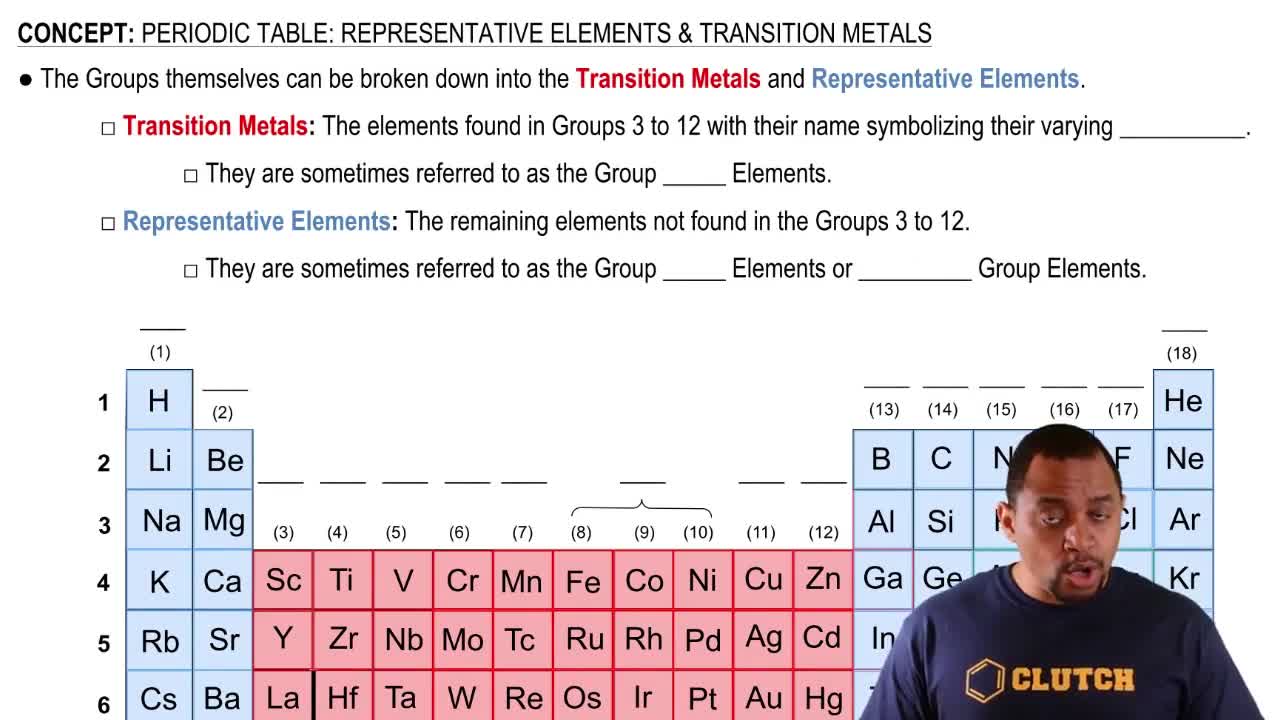
Representative Elements

Representative elements are found in groups 1, 2, and 13-18 of the periodic table. They are characterized by their ability to form a wide variety of compounds and exhibit predictable properties based on their group. Understanding the group number of these elements is essential for predicting their behavior in ionic compounds.
Video consigliato:
Percorso guidato
03:30
Periodic Table: Representative Elements & Transition Metals

Ionic Compounds

Ionic compounds are formed when metals transfer electrons to nonmetals, resulting in the formation of positively charged cations and negatively charged anions. The overall charge of the compound is neutral, and the ratio of ions is determined by their charges. In the case of Al₂X₃, aluminum (Al) has a +3 charge, which helps identify the charge and group of element X.
Video consigliato:
Percorso guidato
02:11
Naming Ionic Compounds

Periodic Table Group Number

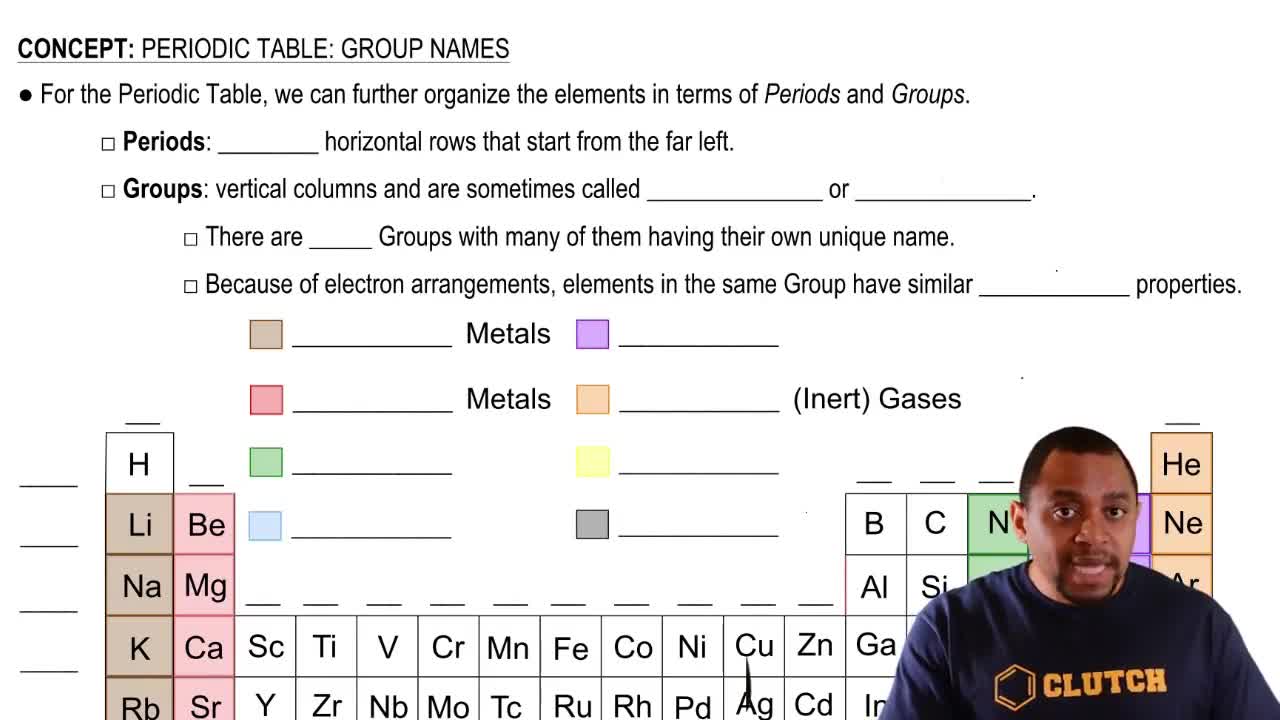
The group number in the periodic table indicates the number of valence electrons in the outer shell of an element. For representative elements, this number helps predict their ionic charge when forming compounds. By analyzing the charges of the ions in Al₂X₃, one can deduce the group number of element X, which is crucial for understanding its chemical properties.
Video consigliato:
Percorso guidato
05:33
Periodic Table: Group Names