Ch.7 Chemical Quantities and Reactions
Timberlake - Chemistry: An Introduction to General, Organic, and Biological Chemistry 13th Edition
Timberlake13th EditionChemistry: An Introduction to General, Organic, and Biological ChemistryISBN: 9780134421353Non è quello che usi tu?Cambia libro di testo
Capitolo 7, Problema 70b

Classify each of the following as exothermic or endothermic:
b. In the body, the synthesis of proteins requires energy.

Guida verificata passo dopo passo
1
Understand the definitions of exothermic and endothermic processes: Exothermic processes release energy (usually in the form of heat) to the surroundings, while endothermic processes absorb energy from the surroundings.
Analyze the given scenario: The synthesis of proteins in the body involves the formation of peptide bonds between amino acids, which is a chemical reaction.
Recall that forming complex molecules (like proteins) from simpler ones (like amino acids) typically requires an input of energy to drive the reaction forward. This is because the process involves overcoming activation energy and creating higher-energy bonds.
Recognize that the energy required for protein synthesis in the body is often supplied by molecules like ATP (adenosine triphosphate), which provides the necessary energy input for the reaction.
Conclude that since the synthesis of proteins requires energy input, it is classified as an endothermic process.

Risposta video verificata per un problema simile:

Questa soluzione video è stata consigliata dai nostri tutor come utile per risolvere questo problema.
Durata del video:
3m

Concetti chiave

Ecco i concetti essenziali che devi comprendere per rispondere correttamente alla domanda.

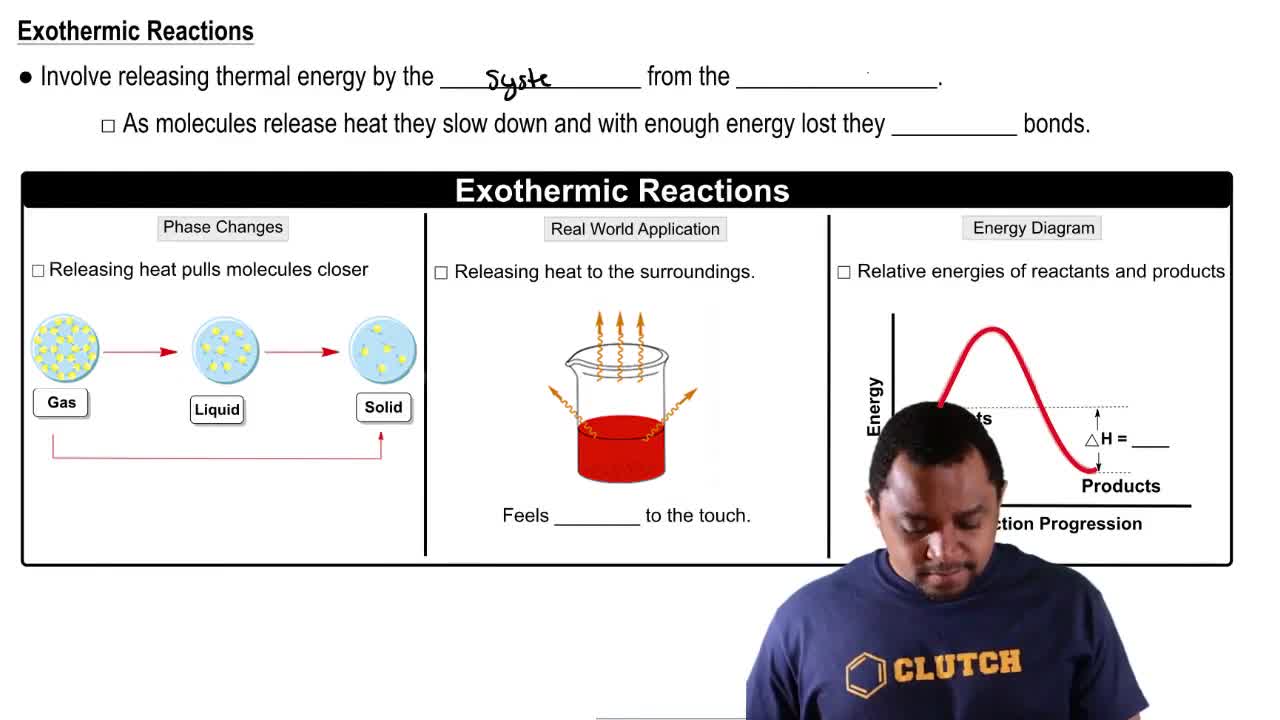
Exothermic Reactions

Exothermic reactions are processes that release energy, usually in the form of heat, to their surroundings. This occurs when the total energy of the products is lower than that of the reactants, resulting in a net release of energy. Common examples include combustion and respiration, where energy is produced as a byproduct.
Video consigliato:
Percorso guidato
02:38
Endothermic & Exothermic Reactions

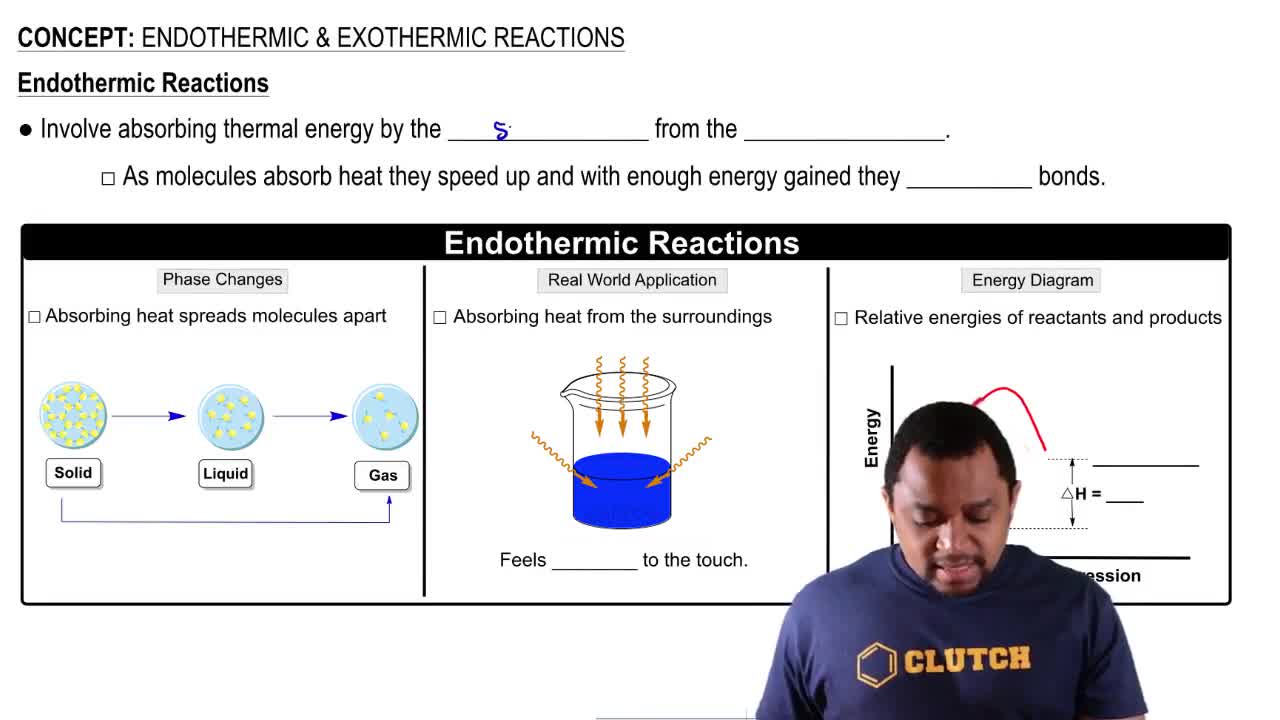
Endothermic Reactions

Endothermic reactions are processes that absorb energy from their surroundings, leading to a decrease in temperature in the environment. In these reactions, the total energy of the products is higher than that of the reactants, requiring an input of energy. Photosynthesis is a classic example, where plants absorb sunlight to convert carbon dioxide and water into glucose.
Video consigliato:
Percorso guidato
02:30
Endothermic & Exothermic Reactions

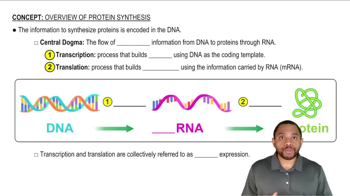
Protein Synthesis

Protein synthesis is the biological process through which cells generate new proteins, essential for various cellular functions. This process is endothermic, as it requires energy input, typically derived from ATP (adenosine triphosphate). During protein synthesis, amino acids are linked together in a specific sequence dictated by mRNA, forming polypeptides that fold into functional proteins.
Video consigliato:
Percorso guidato
1:54
Overview of Protein Synthesis Concept 1