Ch.13 Carbohydrates
Timberlake - Chemistry: An Introduction to General, Organic, and Biological Chemistry 14th Edition
Timberlake14th EditionChemistry: An Introduction to General, Organic, and Biological ChemistryISBN: 9781292472249Non è quello che usi tu?Cambia libro di testo
Capitolo 13, Problema 47a

Describe the similarities and differences in the following:
a. amylose and amylopectin

Guida verificata passo dopo passo
1
Amylose and amylopectin are both polysaccharides composed of glucose monomers, making them similar in their basic building blocks and their role as energy storage molecules in plants.
Amylose is a linear polymer of glucose units connected by α(1→4) glycosidic bonds, meaning the glucose molecules are linked in a straight chain.
Amylopectin, on the other hand, is a branched polymer. It contains α(1→4) glycosidic bonds in the linear sections and α(1→6) glycosidic bonds at the branch points, which occur approximately every 24–30 glucose units.
Amylose tends to form a helical structure due to its linear nature, while amylopectin's branching prevents it from forming such a structure, making it more compact and soluble in water.
Both amylose and amylopectin are components of starch, but their proportions vary depending on the source. For example, in most plants, amylopectin is the predominant component, making up about 70–80% of starch, while amylose constitutes the remaining 20–30%.

Risposta video verificata per un problema simile:

Questa soluzione video è stata consigliata dai nostri tutor come utile per risolvere questo problema.
Durata del video:
1m

Concetti chiave

Ecco i concetti essenziali che devi comprendere per rispondere correttamente alla domanda.

Amylose

Amylose is a linear polysaccharide made up of glucose units connected by α(1→4) glycosidic bonds. It typically forms a helical structure and is less soluble in water compared to amylopectin. Amylose constitutes about 20-30% of starch and is primarily responsible for the gel-like properties of starch when cooked.
Video consigliato:
Percorso guidato
0:50
Intro To Carbohydrate Metabolism Example 1

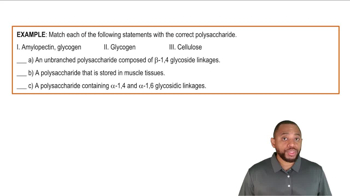
Amylopectin

Amylopectin is a branched polysaccharide, also composed of glucose units, but with both α(1→4) and α(1→6) glycosidic bonds. This branching occurs approximately every 24 to 30 glucose units, resulting in a more complex structure that is more soluble in water and contributes to the thickening properties of starch. Amylopectin makes up about 70-80% of starch.
Video consigliato:
Percorso guidato
1:24
Polysaccharides Example 1

Starch Structure and Function

Starch is a carbohydrate storage molecule in plants, composed of amylose and amylopectin. The ratio of these two components affects the physical properties of starch, such as its solubility, digestibility, and ability to form gels. Understanding the structural differences between amylose and amylopectin is crucial for applications in food science, nutrition, and industrial processes.
Video consigliato:
Percorso guidato
02:16
Logarithmic Functions