Ch.13 Carbohydrates
Timberlake - Chemistry: An Introduction to General, Organic, and Biological Chemistry 14th Edition
Timberlake14th EditionChemistry: An Introduction to General, Organic, and Biological ChemistryISBN: 9781292472249Non è quello che usi tu?Cambia libro di testo
Capitolo 13, Problema 49b

Give the name of one or more polysaccharides that matches each of the following descriptions:
c. contains only α(1→4)-glycosidic bonds

Guida verificata passo dopo passo
1
Step 1: Understand the structure of polysaccharides. Polysaccharides are long chains of monosaccharides linked by glycosidic bonds. The type of glycosidic bond (e.g., α(1→4)) determines the structure and properties of the polysaccharide.
Step 2: Recall what α(1→4)-glycosidic bonds are. These bonds form when the hydroxyl group on the anomeric carbon (carbon-1) of one α-glucose molecule reacts with the hydroxyl group on carbon-4 of another glucose molecule, creating a linear chain.
Step 3: Identify polysaccharides that exclusively contain α(1→4)-glycosidic bonds. One example is amylose, a component of starch, which is a linear polymer of α-glucose units connected solely by α(1→4)-glycosidic bonds.
Step 4: Differentiate amylose from other polysaccharides. For instance, amylopectin and glycogen also contain α(1→4)-glycosidic bonds but include branching points with α(1→6)-glycosidic bonds, so they do not meet the criteria of containing only α(1→4)-glycosidic bonds.
Step 5: Conclude that amylose is a polysaccharide that matches the description of containing only α(1→4)-glycosidic bonds.

Risposta video verificata per un problema simile:

Questa soluzione video è stata consigliata dai nostri tutor come utile per risolvere questo problema.
Durata del video:
3m

Concetti chiave

Ecco i concetti essenziali che devi comprendere per rispondere correttamente alla domanda.

Polysaccharides

Polysaccharides are long chains of monosaccharide units linked by glycosidic bonds. They serve various functions in living organisms, including energy storage and structural support. Common examples include starch, glycogen, and cellulose, each differing in their glycosidic linkages and branching patterns.
Video consigliato:
Percorso guidato
1:24
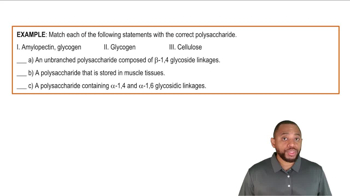
Polysaccharides Example 1

Glycosidic Bonds

Glycosidic bonds are covalent linkages formed between the hydroxyl group of one sugar molecule and the anomeric carbon of another. The type of glycosidic bond influences the properties of the polysaccharide, such as its digestibility and solubility. In this case, α(1→4)-glycosidic bonds indicate a specific linkage that affects the structure and function of the polysaccharide.
Video consigliato:
Percorso guidato
1:44
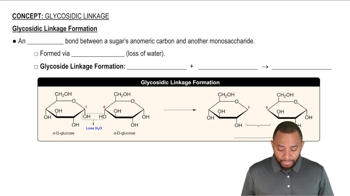
Glycosidic Linkage Formation Concept 1

Starch

Starch is a polysaccharide composed of glucose units linked primarily by α(1→4)-glycosidic bonds, with some α(1→6) branches. It serves as a major energy storage form in plants. The presence of only α(1→4)-glycosidic bonds characterizes amylose, a linear form of starch, which is crucial for understanding the question's requirements.