Ch.15 Lipids
Timberlake - Chemistry: An Introduction to General, Organic, and Biological Chemistry 14th Edition
Timberlake14th EditionChemistry: An Introduction to General, Organic, and Biological ChemistryISBN: 9781292472249Non è quello che usi tu?Cambia libro di testo
Capitolo 15, Problema 87b

 Match the lipoprotein (1 to 4) with its description (a to d).
1. chylomicrons
2. VLDL
3. LDL
4. HDL
b. transports most of the cholesterol to the cells

Guida verificata passo dopo passo
1
Step 1: Understand the problem. The task is to match the given lipoproteins (chylomicrons, VLDL, LDL, HDL) with their respective descriptions. In this case, we are matching one specific description: 'transports most of the cholesterol to the cells.'
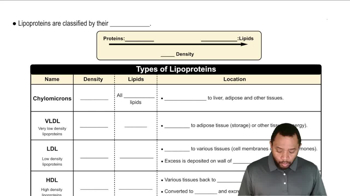
Step 2: Recall the function of each lipoprotein. Lipoproteins are responsible for transporting lipids (fats) in the bloodstream. Each type has a specific role: - Chylomicrons: Transport dietary triglycerides and cholesterol from the intestines to tissues. - VLDL (Very Low-Density Lipoproteins): Transport triglycerides synthesized in the liver to tissues. - LDL (Low-Density Lipoproteins): Known as 'bad cholesterol,' they transport cholesterol to cells. - HDL (High-Density Lipoproteins): Known as 'good cholesterol,' they transport cholesterol from tissues back to the liver for excretion.
Step 3: Focus on the description provided: 'transports most of the cholesterol to the cells.' Based on the functions listed above, identify which lipoprotein is responsible for this task.
Step 4: Match the description to the correct lipoprotein. From the information provided, LDL ('Low-Density Lipoproteins') is responsible for transporting most of the cholesterol to the cells.
Step 5: Conclude that the correct match for the description 'transports most of the cholesterol to the cells' is LDL (option 3).

Risposta video verificata per un problema simile:

Questa soluzione video è stata consigliata dai nostri tutor come utile per risolvere questo problema.
Durata del video:
2m

Concetti chiave

Ecco i concetti essenziali che devi comprendere per rispondere correttamente alla domanda.

Lipoproteins

Lipoproteins are complex particles composed of lipids and proteins that transport fats through the bloodstream. They vary in density and composition, influencing their function in lipid metabolism. The main types include chylomicrons, VLDL, LDL, and HDL, each playing distinct roles in lipid transport and regulation.
Video consigliato:
Percorso guidato
3:52
Lipoproteins for Transport Concept 2

Chylomicrons

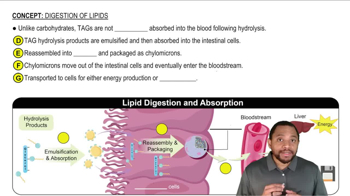
Chylomicrons are the largest lipoproteins, primarily responsible for transporting dietary lipids from the intestines to other tissues. They are rich in triglycerides and are formed in the intestinal lining after a meal. Their primary function is to deliver fats to cells for energy or storage.
Video consigliato:
Percorso guidato
2:48
Digestion of Lipids Concept 1

LDL and HDL

LDL (Low-Density Lipoprotein) and HDL (High-Density Lipoprotein) are crucial for cholesterol transport. LDL is often referred to as 'bad cholesterol' because it delivers cholesterol to cells, which can lead to plaque buildup in arteries. In contrast, HDL is known as 'good cholesterol' as it helps remove excess cholesterol from cells and transports it back to the liver for excretion.
Video consigliato:
Percorso guidato
3:52
Lipoproteins for Transport Concept 2