Ch.15 Lipids
Timberlake - Chemistry: An Introduction to General, Organic, and Biological Chemistry 14th Edition
Timberlake14th EditionChemistry: An Introduction to General, Organic, and Biological ChemistryISBN: 9781292472249Non è quello che usi tu?Cambia libro di testo
Capitolo 15, Problema 84

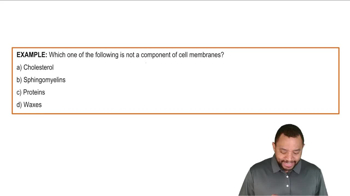
Which of the following are found in cell membranes?
a. proteins
b. waxes
c. phospholipids

Guida verificata passo dopo passo
1
Understand the structure of a cell membrane: The cell membrane is a lipid bilayer that acts as a barrier and regulates the movement of substances in and out of the cell. It is primarily composed of specific types of molecules.
Recall the key components of the cell membrane: The main components are phospholipids, proteins, and cholesterol. Phospholipids form the bilayer structure, while proteins are embedded within or attached to the bilayer, serving various functions such as transport and signaling.
Evaluate the role of phospholipids: Phospholipids are amphipathic molecules (having both hydrophilic and hydrophobic regions) that form the fundamental structure of the membrane. They are essential for the bilayer's formation and function.
Consider the role of proteins: Proteins in the membrane can act as channels, receptors, or enzymes. They are crucial for communication and transport across the membrane.
Analyze the presence of waxes: Waxes are not typically found in cell membranes. They are more commonly associated with protective coatings on surfaces, such as in plants or on the skin of animals, rather than being a structural component of membranes.

Risposta video verificata per un problema simile:

Questa soluzione video è stata consigliata dai nostri tutor come utile per risolvere questo problema.
Durata del video:
2m

Concetti chiave

Ecco i concetti essenziali che devi comprendere per rispondere correttamente alla domanda.

Cell Membrane Structure

Cell membranes are primarily composed of a phospholipid bilayer, which provides a flexible barrier around the cell. This bilayer consists of hydrophilic (water-attracting) heads and hydrophobic (water-repelling) tails, allowing for selective permeability. The arrangement of these molecules is crucial for maintaining the integrity and functionality of the cell.
Video consigliato:
Percorso guidato
1:00
Cell Membranes Example 1

Membrane Proteins

Proteins embedded in the cell membrane play vital roles in various functions, including transport, signaling, and structural support. These proteins can be integral, spanning the membrane, or peripheral, attached to the surface. Their diverse functions are essential for communication and interaction with the cell's environment.
Video consigliato:
Percorso guidato
1:00
Cell Membranes Example 1

Phospholipids

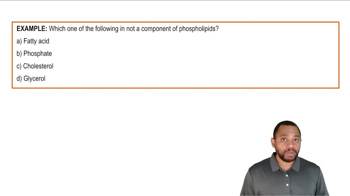
Phospholipids are a key component of cell membranes, consisting of a glycerol backbone, two fatty acid tails, and a phosphate group. Their unique structure allows them to form bilayers, which are fundamental to membrane integrity. Phospholipids also contribute to the fluidity and flexibility of the membrane, enabling the movement of proteins and other molecules.
Video consigliato:
Percorso guidato
1:01
Glycerophospholipids Example 1