Ch.15 Lipids
Timberlake - Chemistry: An Introduction to General, Organic, and Biological Chemistry 14th Edition
Timberlake14th EditionChemistry: An Introduction to General, Organic, and Biological ChemistryISBN: 9781292472249Non è quello che usi tu?Cambia libro di testo
Capitolo 15, Problema 86b

Sunflower seed oil can be used to make margarine. A triacylglycerol in sunflower seed oil contains two linoleic acids and one oleic acid.
b. Using one of the isomers, write the reaction that takes place when sunflower seed oil is used to make solid margarine.

Guida verificata passo dopo passo
1
Identify the chemical structure of the triacylglycerol in sunflower seed oil. It contains two linoleic acid chains (polyunsaturated fatty acids with two double bonds) and one oleic acid chain (monounsaturated fatty acid with one double bond).
Understand the process of hydrogenation. Hydrogenation is a chemical reaction where hydrogen gas (H₂) is added to the double bonds of unsaturated fatty acids in the presence of a catalyst (commonly nickel or platinum). This process converts some or all of the double bonds into single bonds, making the fatty acid chains more saturated.
Write the chemical reaction for the hydrogenation process. Represent the triacylglycerol structure with its double bonds and show the addition of hydrogen (H₂) to the double bonds. For example, each double bond (C=C) reacts with H₂ to form a single bond (C-C).
Indicate the result of partial hydrogenation. In partial hydrogenation, not all double bonds are converted to single bonds. Some double bonds may remain, and in some cases, cis double bonds may be converted to trans double bonds, forming trans fats. This step is crucial in the production of margarine, as it gives the product a semi-solid consistency.
Summarize the reaction. The triacylglycerol in sunflower seed oil undergoes hydrogenation, where hydrogen is added to the double bonds of the linoleic and oleic acid chains. The product is a more saturated triacylglycerol, which is solid or semi-solid at room temperature, suitable for margarine production.

Risposta video verificata per un problema simile:

Questa soluzione video è stata consigliata dai nostri tutor come utile per risolvere questo problema.
Durata del video:
5m

Concetti chiave

Ecco i concetti essenziali che devi comprendere per rispondere correttamente alla domanda.

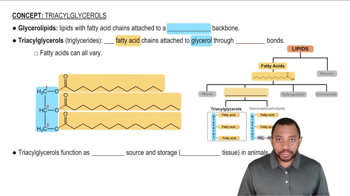
Triacylglycerols

Triacylglycerols, or triglycerides, are the main constituents of body fat in humans and animals, as well as vegetable fat. They are composed of three fatty acid molecules esterified to a glycerol backbone. In the context of sunflower seed oil, the specific composition of fatty acids, such as linoleic and oleic acids, influences the physical properties of the resulting margarine.
Video consigliato:
Percorso guidato
1:52
Triacylglycerols Concept 1

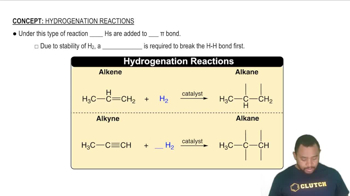
Hydrogenation

Hydrogenation is a chemical reaction that involves the addition of hydrogen to unsaturated fatty acids, converting them into saturated fats. This process is crucial in margarine production, as it solidifies the oil by increasing its melting point, resulting in a spreadable product. The degree of hydrogenation affects the texture and stability of margarine.
Video consigliato:
Percorso guidato
1:22
Hydrogenation Reactions Concept 1

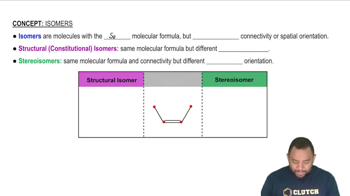
Isomers

Isomers are compounds that have the same molecular formula but different structural arrangements or configurations. In the case of fatty acids, isomers can vary in the position of double bonds or the orientation of functional groups, which can significantly impact their physical and chemical properties. Understanding isomers is essential for predicting the behavior of the fatty acids during the hydrogenation process.
Video consigliato:
Percorso guidato
2:16
Isomers Concept 1