
Ch.8 Gases
Timberlake - Chemistry: An Introduction to General, Organic, and Biological Chemistry 14th Edition
Timberlake14th EditionChemistry: An Introduction to General, Organic, and Biological ChemistryISBN: 9781292472249Non è quello che usi tu?Cambia libro di testo
Capitolo 8, Problema 78a

A mixture of nitrogen (N2) and helium has a volume of 365 mL at 30 °C and a total pressure of 745 mmHg. (8.5, 8.6, 8.7)
a. If the partial pressure of helium is 65 mmHg, what is the partial pressure of the nitrogen?

Guida verificata passo dopo passo
1
Step 1: Understand Dalton's Law of Partial Pressures, which states that the total pressure of a gas mixture is the sum of the partial pressures of each individual gas. Mathematically, this can be expressed as: Ptotal = PHe + PN2, where Ptotal is the total pressure, PHe is the partial pressure of helium, and PN2 is the partial pressure of nitrogen.
Step 2: Identify the given values from the problem. The total pressure of the gas mixture is 745 mmHg, and the partial pressure of helium is 65 mmHg.
Step 3: Rearrange Dalton's Law equation to solve for the partial pressure of nitrogen: PN2 = Ptotal - PHe.
Step 4: Substitute the known values into the equation: PN2 = 745 - 65 mmHg.
Step 5: Perform the subtraction to find the partial pressure of nitrogen. This will give you the value of PN2.

Risposta video verificata per un problema simile:

Questa soluzione video è stata consigliata dai nostri tutor come utile per risolvere questo problema.
Durata del video:
2m

Concetti chiave

Ecco i concetti essenziali che devi comprendere per rispondere correttamente alla domanda.

Dalton's Law of Partial Pressures

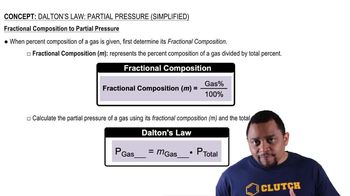
Dalton's Law states that in a mixture of gases, the total pressure exerted is equal to the sum of the partial pressures of each individual gas. This principle is crucial for solving problems involving gas mixtures, as it allows us to isolate the contribution of each gas to the overall pressure.
Video consigliato:
Percorso guidato
01:02
Dalton's Law: Partial Pressure (Simplified) Concept 3

Partial Pressure

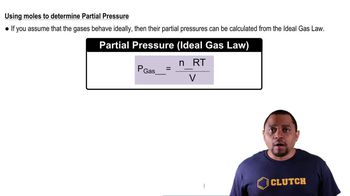
Partial pressure refers to the pressure that a single gas in a mixture would exert if it occupied the entire volume alone at the same temperature. Understanding partial pressures is essential for calculating the individual contributions of gases in a mixture, particularly when using Dalton's Law.
Video consigliato:
Percorso guidato
00:48
Dalton's Law: Partial Pressure (Simplified) Concept 2

Ideal Gas Law

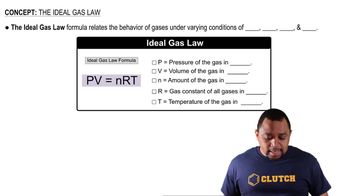
The Ideal Gas Law (PV=nRT) relates the pressure, volume, temperature, and number of moles of a gas. While not directly needed for this specific question, it provides a foundational understanding of gas behavior and can be useful in broader contexts involving gas calculations.
Video consigliato:
Percorso guidato
01:15
The Ideal Gas Law Concept 1