Ch. 11 - Characterizing and Classifying Prokaryotes
Bauman - Microbiology with Diseases by Taxonomy 6th Edition
Bauman6th EditionMicrobiology with Diseases by TaxonomyISBN: 9780134832302Non è quello che usi tu?Cambia libro di testo
Capitolo 11, Problema 4

For each of the following statements that is true, write “true” in the blank. For each statement that is false, write the word(s) that should be substituted for the underlined word(s) to make the statement correct.
__________ Chlamydias have peptidoglycan cell walls.

Guida verificata passo dopo passo
1
Recall the structural characteristics of Chlamydias, which are a group of obligate intracellular bacteria.
Understand that peptidoglycan is a key component of most bacterial cell walls, providing rigidity and shape.
Note that Chlamydias are unique because they lack a typical peptidoglycan layer in their cell walls, which is unusual for bacteria.
Therefore, the statement 'Chlamydias have peptidoglycan cell walls' is false.
To correct the statement, replace 'peptidoglycan cell walls' with 'a reduced or absent peptidoglycan layer' or 'an atypical cell wall lacking peptidoglycan'.

Risposta video verificata per un problema simile:

Questa soluzione video è stata consigliata dai nostri tutor come utile per risolvere questo problema.
Durata del video:
1m

Concetti chiave

Ecco i concetti essenziali che devi comprendere per rispondere correttamente alla domanda.

Chlamydias and Their Cell Wall Structure

Chlamydias are a group of obligate intracellular bacteria known for their unique cell wall structure. Unlike typical Gram-negative bacteria, they lack a classical peptidoglycan layer, which is unusual for bacteria. Instead, their cell walls contain a reduced or modified peptidoglycan-like substance, contributing to their distinct biology.
Video consigliato:
02:59
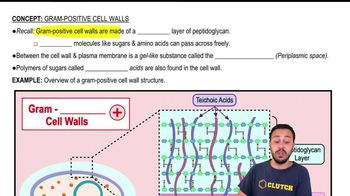
Gram-Positive Cell Walls

Peptidoglycan Composition and Function

Peptidoglycan is a polymer that forms a rigid layer outside the plasma membrane of most bacteria, providing structural support and shape. It is essential for bacterial survival and is the target of many antibiotics. The presence or absence of peptidoglycan is a key factor in bacterial classification and antibiotic susceptibility.
Video consigliato:
06:04
Functional Groups

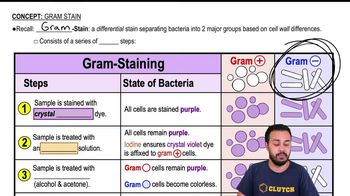
Gram Staining and Bacterial Cell Wall Differences

Gram staining differentiates bacteria based on their cell wall composition, primarily the thickness of peptidoglycan. Gram-positive bacteria have thick peptidoglycan layers, while Gram-negative bacteria have thin layers plus an outer membrane. Chlamydias do not fit neatly into this scheme due to their atypical cell wall lacking typical peptidoglycan.
Video consigliato:
04:57
Gram Stain