Explain why Gram-positive mycoplasmas appear pink in a Gram-stained smear.
Ch. 19 - Pathogenic Gram-Positive Bacteria
Bauman6th EditionMicrobiology with Diseases by TaxonomyISBN: 9780134832302Non è quello che usi tu?Cambia libro di testo
Capitolo 19, Problema 5
Why do pediatricians recommend that children under one year never be fed honey?
Guida verificata passo dopo passo1
Understand that honey can contain spores of the bacterium Clostridium botulinum, which is harmless to older children and adults due to their mature digestive systems and gut flora.
Recognize that infants under one year have an immature digestive system and a less developed gut microbiome, which makes them more susceptible to colonization by Clostridium botulinum spores.
Learn that when these spores germinate in the infant's intestines, they can produce botulinum toxin, leading to infant botulism, a serious and potentially fatal illness characterized by muscle weakness and respiratory problems.
Note that because of this risk, pediatricians recommend avoiding feeding honey to children under one year to prevent exposure to these spores.
Summarize that the key reason is the prevention of infant botulism caused by Clostridium botulinum spores present in honey, which infants cannot safely handle due to their immature digestive defenses.

Risposta video verificata per un problema simile:
Questa soluzione video è stata consigliata dai nostri tutor come utile per risolvere questo problema.
Durata del video:
1mConcetti chiave
Ecco i concetti essenziali che devi comprendere per rispondere correttamente alla domanda.
Botulism and Clostridium botulinum Spores
Honey can contain spores of Clostridium botulinum, a bacterium that produces botulinum toxin. In infants under one year, these spores can germinate in the immature gut, leading to infant botulism, a serious paralytic illness.
Video consigliato:
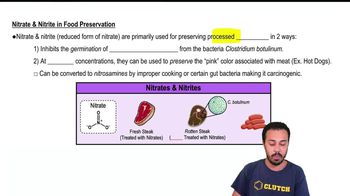
Nitrate & Nitrite in Food Preservation
Infant Gut Microbiota and Immune System Development
The digestive and immune systems of infants under one year are not fully developed, making them more susceptible to infections. Their gut lacks the mature microbiota that inhibits harmful bacteria like C. botulinum from colonizing.
Video consigliato:
Introduction to Cells of the Immune System
Symptoms and Risks of Infant Botulism
Infant botulism can cause muscle weakness, poor feeding, constipation, and respiratory difficulties. Early exposure to honey increases the risk, so pediatricians advise avoiding honey to prevent this potentially life-threatening condition.
Video consigliato:
Overall Risk of Infection
Pratica correlata
Domanda del libro di testo
1940
views
Domanda del libro di testo
A bacterium associated with bacteremia, meningitis, and pneumonia in newborns is
a. Staphylococcus aureus
b. Staphylococcus epidermidis
c. Streptococcus pyogenes
d. Streptococcus agalactiae
1214
views
Domanda del libro di testo
Which type of anthrax is more common in animals and in humans?
a. Cutaneous anthrax
b. Inhalation anthrax
c. Gastrointestinal anthrax
d. Mucoid anthrax
1129
views
Domanda del libro di testo
Explain how mice are used in the diagnosis of botulism poisoning.
1253
views
Domanda del libro di testo
Contrast tuberculoid leprosy with lepromatous leprosy in terms of pathogenesis. How does the cellular immune response of a patient affect the form of the disease?
1128
views
Domanda del libro di testo
Of the following genera, which can survive the harshest conditions?
a. Staphylococcus
b. Clostridium
c. Mycobacterium
d. Actinomyces
1422
views