_______ is a cyclic series of eight reactions involved in the catabolism of acetyl-CoA that yields eight molecules of NADH and two molecules of FADH2.
Ch. 5 - Microbial Metabolism
Bauman6th EditionMicrobiology with Diseases by TaxonomyISBN: 9780134832302Non è quello che usi tu?Cambia libro di testo
Capitolo 5, Problema 5
Explain the mechanism of negative feedback with respect to enzyme action.
Guida verificata passo dopo passo1
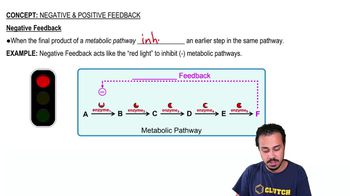
Begin by defining negative feedback in the context of enzyme action: it is a regulatory mechanism where the end product of a metabolic pathway inhibits an enzyme involved earlier in the pathway to prevent overproduction.
Identify the key components involved: the enzyme (usually an early enzyme in the pathway), the substrate, and the end product that acts as the feedback inhibitor.
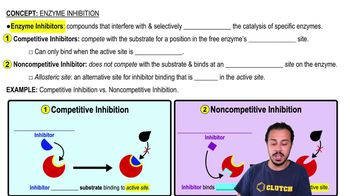
Explain how the end product binds to the enzyme at a site other than the active site, known as the allosteric site, causing a conformational change that reduces the enzyme's activity.
Describe how this reduction in enzyme activity decreases the conversion of substrate to product, thereby lowering the concentration of the end product.
Conclude by noting that when the concentration of the end product falls below a certain level, the inhibition is relieved, allowing the enzyme to become active again and the pathway to proceed, thus maintaining homeostasis.

Risposta video verificata per un problema simile:
Questa soluzione video è stata consigliata dai nostri tutor come utile per risolvere questo problema.
Durata del video:
2mConcetti chiave
Ecco i concetti essenziali che devi comprendere per rispondere correttamente alla domanda.
Enzyme Action
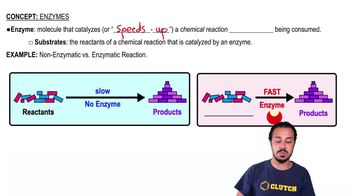
Enzymes are biological catalysts that speed up chemical reactions by lowering activation energy. They bind to specific substrates at their active sites, forming enzyme-substrate complexes, which then convert substrates into products efficiently.
Video consigliato:
Enzymes
Negative Feedback Mechanism
Negative feedback is a regulatory process where the end product of a pathway inhibits an earlier step to maintain balance. This prevents overproduction by reducing enzyme activity when sufficient product accumulates.
Video consigliato:
Negative Feedback
Allosteric Regulation in Enzymes
Allosteric regulation involves molecules binding to sites other than the active site, causing conformational changes that alter enzyme activity. In negative feedback, the product often acts as an allosteric inhibitor, decreasing enzyme function to control the pathway.
Video consigliato:
Enzyme Inhibition
Pratica correlata
Domanda del libro di testo
1291
views
Domanda del libro di testo
The final electron acceptor in aerobic respiration is ________.
1292
views
Domanda del libro di testo
Three common inorganic electron acceptors in anaerobic respiration are _______,_______, and _______.
937
views
Domanda del libro di testo
For the phrase given below, indicate the type of metabolism referred to, using the following choices:
a. Anabolism only
b. Both anabolism and catabolism (amphibolic)
c. Catabolism only
Involves the production of cell membrane constituents
747
views
Domanda del libro di testo
How does a noncompetitive inhibitor at a single allosteric site affect a whole pathway of enzymatic reactions?
1434
views
Domanda del libro di testo
Photosynthetic bacteria that also fix nitrogen are:
a. Mycoplasmas
b. Spirilla
c. Bacteroids
d. Cyanobacteria
1272
views