Ch. 6 - Microbial Nutrition and Growth
Bauman - Microbiology with Diseases by Taxonomy 6th Edition
Bauman6th EditionMicrobiology with Diseases by TaxonomyISBN: 9780134832302Non è quello che usi tu?Cambia libro di testo
Capitolo 6, Problema 3

All cells recycle the essential element ___________ from amino acids and nucleotides.

Guida verificata passo dopo passo
1
Identify the essential element that is commonly found in both amino acids and nucleotides. Consider the elements that are part of the molecular structure of these biomolecules.
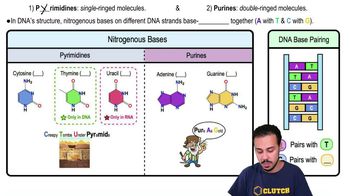
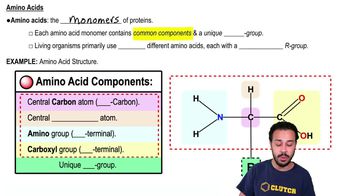
Recall that amino acids contain nitrogen in their amino group (-NH2), and nucleotides also contain nitrogen in their nitrogenous bases (adenine, thymine, cytosine, guanine, uracil).
Understand that cells recycle this element because it is vital for synthesizing new amino acids and nucleotides, which are building blocks for proteins and nucleic acids respectively.
Recognize that the element being recycled is nitrogen, as it is essential and often limiting in biological systems, so cells have mechanisms to recover and reuse nitrogen from degraded amino acids and nucleotides.
Conclude that the blank in the sentence should be filled with 'nitrogen' because it is the essential element recycled from amino acids and nucleotides by all cells.

Risposta video verificata per un problema simile:

Questa soluzione video è stata consigliata dai nostri tutor come utile per risolvere questo problema.
Durata del video:
1m

Concetti chiave

Ecco i concetti essenziali che devi comprendere per rispondere correttamente alla domanda.

Nitrogen Recycling in Cells

Cells recycle nitrogen, an essential element found in amino acids and nucleotides, to conserve resources and maintain metabolic balance. This process involves breaking down these molecules to recover nitrogen for new biosynthesis, ensuring efficient use of this vital nutrient.
Video consigliato:
07:21
5 Nitrogenous Bases

Amino Acids and Nucleotides as Nitrogen Sources

Amino acids and nucleotides contain nitrogen atoms in their structures, making them primary sources of nitrogen within the cell. When these molecules are degraded, nitrogen is released and can be reused for synthesizing new biomolecules, supporting cellular growth and function.
Video consigliato:
04:37
Amino Acids

Nitrogen Assimilation Pathways

Cells use specific biochemical pathways, such as the glutamine synthetase-glutamate synthase system, to assimilate recycled nitrogen into organic compounds. These pathways convert inorganic nitrogen into amino acids and nucleotides, enabling continuous cellular metabolism and biosynthesis.
Video consigliato:
04:40
1) Alternative Pathway