Hyperthermophilic prokaryotes may remain viable in canned goods after commercial sterilization. Why is this situation not dangerous to consumers?
Ch. 9 - Controlling Microbial Growth in the Environment
Bauman6th EditionMicrobiology with Diseases by TaxonomyISBN: 9780134832302Non è quello che usi tu?Cambia libro di testo
Tutti i libri di testo
Bauman 6th Edition
Ch. 9 - Controlling Microbial Growth in the Environment
Problema 10
Bauman 6th Edition
Ch. 9 - Controlling Microbial Growth in the Environment
Problema 10Capitolo 9, Problema 10
Compare and contrast the action of alcohols, halogens, and oxidizing agents in controlling microbial growth.
Guida verificata passo dopo passo1
Step 1: Define the general mechanism of action for alcohols in microbial control. Explain that alcohols, such as ethanol and isopropanol, primarily denature proteins and disrupt cell membranes, leading to leakage of cellular contents and cell death. Emphasize their effectiveness against bacteria and enveloped viruses but limited action on spores.
Step 2: Describe how halogens, like chlorine and iodine, control microbial growth. Highlight that halogens act by oxidizing cellular components, including proteins and nucleic acids, and can penetrate cell walls to cause irreversible damage. Note their broad-spectrum activity, including effectiveness against bacteria, viruses, fungi, and spores (depending on concentration and exposure).
Step 3: Explain the role of oxidizing agents such as hydrogen peroxide and peracetic acid. Discuss that these agents produce reactive oxygen species that damage proteins, lipids, and DNA, leading to oxidative stress and cell death. Mention their ability to kill a wide range of microorganisms, including spores, due to strong oxidizing properties.
Step 4: Compare the spectrum of activity and limitations of each group. For example, alcohols are rapid and effective but not sporicidal; halogens are broad-spectrum but can be inactivated by organic matter; oxidizing agents are potent and sporicidal but may be unstable or corrosive.
Step 5: Summarize the practical applications and considerations for each agent in microbial control, such as alcohols being used for skin antisepsis, halogens for water disinfection, and oxidizing agents for sterilization of medical equipment.

Risposta video verificata per un problema simile:
Questa soluzione video è stata consigliata dai nostri tutor come utile per risolvere questo problema.
Durata del video:
2mConcetti chiave
Ecco i concetti essenziali che devi comprendere per rispondere correttamente alla domanda.
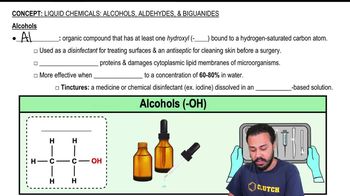
Mechanism of Action of Alcohols
Alcohols, such as ethanol and isopropanol, control microbial growth primarily by denaturing proteins and dissolving lipids in the cell membrane. This disrupts membrane integrity, leading to leakage of cellular contents and cell death. They are effective against bacteria and enveloped viruses but less so against spores.
Video consigliato:
Alcohols
Role of Halogens in Microbial Control
Halogens like chlorine and iodine act as strong oxidizing agents that disrupt microbial proteins and nucleic acids. They penetrate cells and oxidize essential enzymes, leading to cell death. Halogens are broad-spectrum antimicrobials effective against bacteria, viruses, fungi, and spores under certain conditions.
Video consigliato:
Liquid Chemicals: Halogens
Function of Oxidizing Agents
Oxidizing agents such as hydrogen peroxide and peracetic acid kill microbes by producing reactive oxygen species that damage cellular components including DNA, proteins, and lipids. They are effective against a wide range of microorganisms, including spores, and are often used for sterilization and disinfection.
Video consigliato:
Pyruvate Oxidation
Pratica correlata
Domanda del libro di testo
809
views
Domanda del libro di testo
Which of the following substances would most effectively inhibit anaerobes?
a. Phenol
b. Silver
c. Ethanol
d. Hydrogen peroxide
697
views
Domanda del libro di testo
Which of the following types of radiation is more widely used as an antimicrobial technique?
a. Electron beams
b. Visible light waves
c. Radio waves
d. Microwaves
789
views
Domanda del libro di testo
The preservation of beef jerky from microbial growth relies on which method of microbial control?
a. Filtration
b. Lyophilization
c. Desiccation
d. Radiation
1015
views
Domanda del libro di testo
Which of the following adjectives best describes a surgical procedure that is free of microbial contaminants?
a. Disinfected
b. Sanitized
c. Degermed
d. Aseptic
780
views
Domanda del libro di testo
Compare and contrast desiccation and lyophilization.
1008
views