Ch. 9 - Controlling Microbial Growth in the Environment
Bauman - Microbiology with Diseases by Taxonomy 6th Edition
Bauman6th EditionMicrobiology with Diseases by TaxonomyISBN: 9780134832302Non è quello che usi tu?Cambia libro di testo
Capitolo 9, Problema 9

Compare and contrast desiccation and lyophilization.

Guida verificata passo dopo passo
1
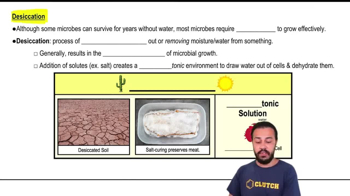
Define desiccation: It is a process of drying out microorganisms by removing water, typically through exposure to air or heat, which inhibits microbial growth by depriving cells of the moisture needed for metabolic activities.
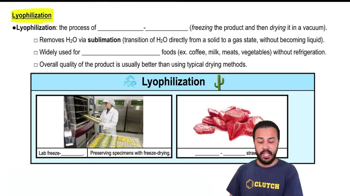
Define lyophilization (freeze-drying): It is a preservation method where microorganisms are first frozen and then subjected to a vacuum to remove water by sublimation, allowing long-term storage while maintaining cell viability.
Compare the effects on microorganisms: Desiccation generally inhibits growth but may not kill all microbes, as some can survive in a dormant state; lyophilization preserves microbes in a viable state for rehydration and use later.
Contrast the mechanisms: Desiccation removes water by evaporation at ambient or elevated temperatures, which can damage cells, whereas lyophilization removes water by sublimation under low temperature and pressure, minimizing damage.
Summarize applications: Desiccation is often used for short-term microbial control or food preservation, while lyophilization is widely used for long-term storage of microbial cultures, vaccines, and pharmaceuticals.

Risposta video verificata per un problema simile:

Questa soluzione video è stata consigliata dai nostri tutor come utile per risolvere questo problema.
Durata del video:
3m

Concetti chiave

Ecco i concetti essenziali che devi comprendere per rispondere correttamente alla domanda.

Desiccation

Desiccation is the process of removing moisture from microorganisms by drying, which inhibits their growth by depriving them of water necessary for metabolic activities. It is a simple preservation method but may not kill all microbes, as some can survive in a dormant state.
Video consigliato:
03:38
Desiccation

Lyophilization (Freeze-Drying)

Lyophilization involves freezing the material and then reducing the surrounding pressure to allow frozen water to sublimate directly from solid to gas. This method preserves microbial cells by removing moisture while maintaining structural integrity and viability for long-term storage.
Video consigliato:
02:24
Lyophilization

Comparison of Preservation Effects

While both desiccation and lyophilization remove water to inhibit microbial growth, desiccation is less controlled and may damage cells, whereas lyophilization better preserves cell viability and structure. Lyophilization is preferred for long-term storage, whereas desiccation is simpler but less effective.
Video consigliato:
01:32
Effects of the Complement System