Indietro
 Bruice 8th EditionCh. 19 - More About Amines • Reactions of Heterocyclic Compounds
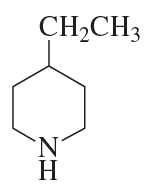
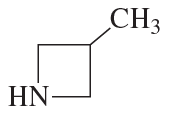
Problema 1c,d
Name the following:
c.
d.
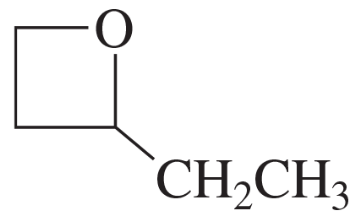
Problema 1e
Name the following:
e.
Problema 1f
Name the following:
f.
Problema 3
Why is the conjugate acid of morpholine more acidic than the conjugate acid of piperidine?
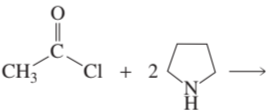
Problema 5b
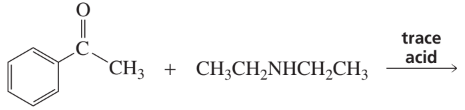
Draw the product of each of the following reactions:
b.
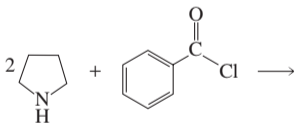
Problema 5d
Draw the product of each of the following reactions:
d.
Problema 7
Explain why cyclopentadiene (pKa = 15) is more acidic than pyrrole (pKa ∼17), even though nitrogen is more electronegative than carbon.
Problema 8
When pyrrole is added to a dilute solution of D2SO4 in D2O, 2-deuteriopyrrole is formed. Propose a mechanism to account for the formation of this compound.
Problema 10a
Draw the product formed when pyridine reacts with ethyl bromide
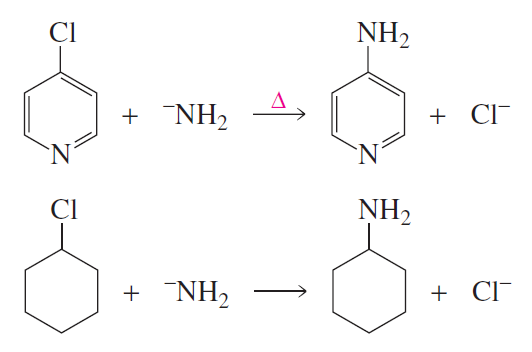
Problema 11
How do the mechanisms of the following reactions differ?
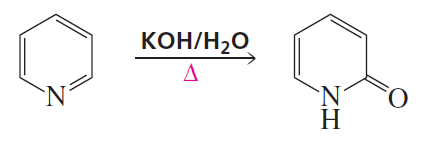
Problema 12a
Propose a mechanism for the following reaction:
Problema 12b
What other product is formed in this reaction?
Problema 13
Rank the following compounds from easiest to hardest at removing a proton from its methyl substituent:
Problema 15
Rank imidazole, pyrrole, and benzene from most reactive to least reactive toward electrophilic aromatic substitution.
Problema 16a
Imidazole boils at 257 °C, whereas N-methylimidazole boils at 199 °C. Explain the difference in boiling points.
Problema 17
Why is imidazole a stronger acid (pKa ~ 14.4) than pyrrole (pKa ~ 17)?
Problema 18a
What percent of imidazole is protonated at physiological pH (7.4)?
Problema 20
Why is protonated pyrimidine (pKa = 1.0) more acidic than protonated pyridine (pKa = 5.2)?
Problema 22a
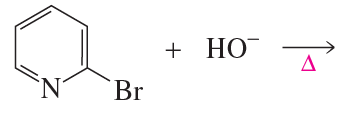
What are the products of the following reactions?
a.
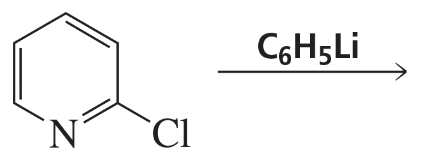
Problema 22b
What are the products of the following reactions?
b.
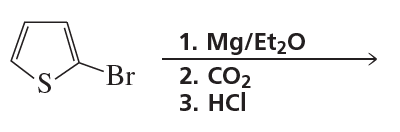
Problema 22d
What are the products of the following reactions?
d.
Problema 22e
What are the products of the following reactions?
e.
Problema 22g
What are the products of the following reactions?
g.
Problema 22i
What are the products of the following reactions?
i.
Problema 25
Rank the following compounds from most reactive to least reactive in an electrophilic aromatic substitution reaction:
Problema 26
One of the following compounds undergoes electrophilic aromatic substitution predominantly at C-3, and one undergoes electrophilic aromatic substitution predominantly at C-4. Which is which?
Problema 27
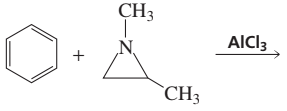
Benzene undergoes electrophilic aromatic substitution reactions with aziridines in the presence of a Lewis acid such as AlCl3.
a. What are the major and minor products of the following reaction?
b. Would you expect epoxides to undergo similar reactions?
Problema 28
Pyrrole reacts with excess para-(N,N-dimethylamino)benzaldehyde to form a highly colored compound. Draw the structure of the colored compound.
Problema 30a,b
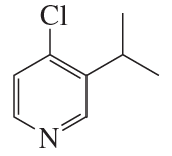
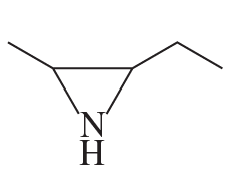
Name the following:
a.
b.
Problema 30c
Name the following:
c.