Indietro
Problema 4
Show the mechanism for the generation of the acylium ion if an acid anhydride is used instead of an acyl chloride for the source of the acylium ion.
Problema 5e,f
What is the major product of a Friedel–Crafts alkylation using the following alkyl chlorides?
e. (CH3)2CHCH2Cl
f. CH2=CHCH2Cl
Problema 10c
Draw a structure for each of the following:
c. o-nitroaniline
Problema 10d
Draw a structure for each of the following:
d. m-chlorobenzonitrile
Problema 11c
Draw a structure for each of the following:
c. 4-bromo-3-chloroaniline
Problema 12a
Correct the following incorrect names:
a. 2,4,6-tribromobenzene
Problema 12b
Correct the following incorrect names:
b. 3-hydroxynitrobenzene
Problema 12c,d
Correct the following incorrect names:
c. para-methylbromobenzene
d. 1,6-dichlorobenzene
Problema 12e,f
Correct the following incorrect names:
e. meta-bromotoluene
f. 6-ethyl-4-iodoaniline
Problema 14
Explain why fluorobenzene is more reactive than chlorobenzene toward electrophilic aromatic substitution but chloromethylbenzene is more reactive than fluoromethylbenzene.
Problema 15a
List the compounds in each set from most reactive to least reactive toward electrophilic aromatic substitution:
a. benzene, phenol, toluene, nitrobenzene, bromobenzene
Problema 15b
List the compounds in each set from most reactive to least reactive toward electrophilic aromatic substitution:
b. dichloromethylbenzene, difluoromethylbenzene, toluene, chloromethylbenzene
Problema 16a
Draw the resonance contributors for:
a. benzaldehyde
Problema 17e,f
What product(s) result from nitration of each of the following?
e. benzenesulfonic acid
f. cyclohexylbenzene
- For each horizontal row of substituted benzenes, indicate b. the one that is the least reactive in an electrophilic aromatic substitution reaction.
Problema 18
Problema 18a,b,c
Are the following substituents ortho–para directors or meta directors?
a. CH=CHC≡N
b. NO2
c. CH2OH
Problema 18d,e,f
Are the following substituents ortho–para directors or meta directors?
d. COOH
e. CF3
f. N=O
Problema 20a
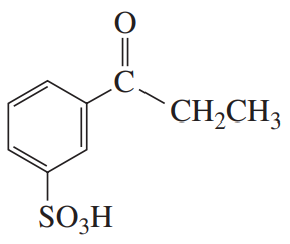
What products are obtained from the reaction of the following compounds with one equivalent of Br2, using FeBr3 as a catalyst?
a.
Problema 20b
What products are obtained from the reaction of the following compounds with one equivalent of Br2, using FeBr3 as a catalyst?
b.
Problema 20c,d
What products are obtained from the reaction of the following compounds with one equivalent of Br2, using FeBr3 as a catalyst?
c.
d.
Problema 21a,b
Give the products, if any, of each of the following reactions:
a. benzonitrile + methyl chloride + AlCl3
b. phenol + Br2
Problema 21c,d
Give the products, if any, of each of the following reactions:
c. benzoic acid + CH3CH2Cl + AlCl3
d. benzene + 2 CH3Cl + AlCl3
Problema 22
a. Does a coupling reaction have to be used to synthesize p-dipropylbenzene?
b. Can a coupling reaction be used to synthesize p-dipropylbenzene?
Problema 23a
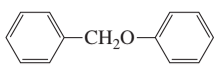
Show how the following compounds can be synthesized from benzene:
a.
Problema 23b
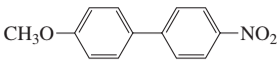
Show how the following compounds can be synthesized from benzene:
b.
Problema 24a
Show how each of the following compounds can be synthesized from benzene:
a. o-bromopropylbenzene
Problema 24d
Show how each of the following compounds can be synthesized from benzene:
d. p-chloroaniline
Problema 24f
Show how each of the following compounds can be synthesized from benzene:
f. m-xylene
Problema 24g
Show how each of the following compounds can be synthesized from benzene:
g. 2-phenylpropene
Problema 24h
Show how each of the following compounds can be synthesized from benzene:
h. m-bromopropylbenzene