Indietro
 Bruice 8th EditionCh. 5 - Alkenes: Structure, Nomenclature, and an Introduction to Reactivity • Thermodynamics and Kinetics
Problema 1
What is the molecular formula for a 5-carbon hydrocarbon with one bond and one ring?
Problema 2a
What is the molecular formula for each of the following?
a. a 4-carbon hydrocarbon with two bonds and no rings
Problema 2(b)
Name the following:
b.
Problema 2b
What is the molecular formula for each of the following?
b. a 10-carbon hydrocarbon with one bond and 2 rings
Problema 4c,d
Determine the degree of unsaturation for hydrocarbons with the following molecular formulas:
c. C12H20
d. C40H56
Problema 5a
Determine the degree of unsaturation and then draw possible structures for noncyclic compounds with the following molecular formulas:
a. C3H6
Problema 5b
Determine the degree of unsaturation and then draw possible structures for noncyclic compounds with the following molecular formulas:
b. C3H4
Problema 6a
Several studies have shown that β-carotene, a precursor of vitamin A, may play a role in preventing cancer. β-Carotene has a molecular formula of C40H56, and it contains two rings and no triple bonds. How many double bonds does it have?
Problema 7a,b
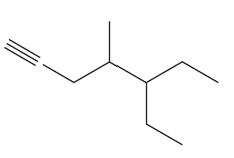
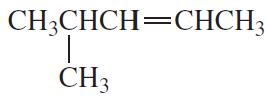
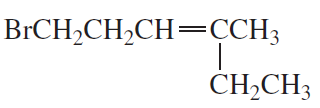
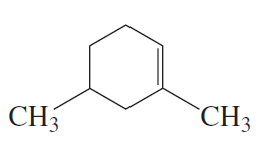
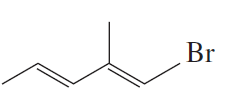
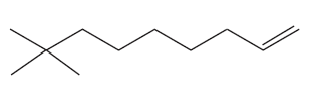
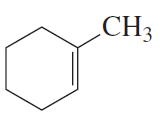
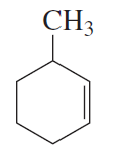
What is each compound's systematic name?
a.
b.
Problema 7c,d
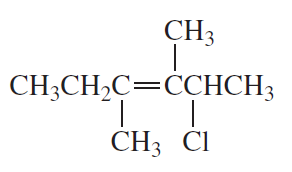
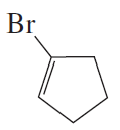
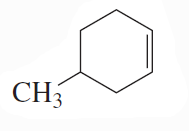
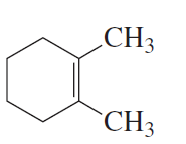
What is each compound's systematic name?
c.
d.
Problema 7e,f
What is each compound's systematic name?
e.
f.
Problema 7g,h
What is each compound's systematic name?
g.
h.
Problema 8a
a. How many vinylic hydrogens does cyclopentene have?
b. How many allylic hydrogens does it have?
Problema 9a,b
Draw the structure for each of the following:
a. 3,3-dimethylcyclopentene
b. 6-bromo-2,3-dimethyl-2-hexene
Problema 9c,d
Draw the structure for each of the following:
c. ethyl vinyl ether
d. allyl alcohol
Problema 10
How many carbons are in the planar double-bond system in the following compound?
Problema 11
How many carbons are in the planar double-bond system in each of the following compounds?
a.
b.
c.
Problema 12a
Draw the isomers for the following compounds and then name each one:
a. 2-methyl-2,4-hexadiene
Problema 12b
Draw the isomers for the following compounds and then name each one:
b. 2,4-heptadiene
Problema 12c
Draw the isomers for the following compounds and then name each one:
c. 1,3-pentadiene
Problema 14
Identify the nucleophile and the electrophile in the following acid–base reactions:
a.
b.
Problema 15a,b
Use curved arrows to show the movement of electrons in the following reaction steps
a.
b.
Problema 16a,b
For each of the reactions in Problem 15, indicate which reactant is the nucleophile and which is the electrophile.
a.
b.
Problema 18b
Calculate ∆G° for the conversion of “axial” methylcyclohexane to “equatorial” methylcyclohexane at 25 °C.
Problema 19
The ∆G° for conversion of “axial” fluorocyclohexane to “equatorial” fluorocyclohexane at 25 °C is -0.25kcal/mol. Calculate the percentage of fluorocyclohexane molecules that have the fluoro substituent in an equatorial position at equilibrium.
Problema 20a
Calculate the percentage of isopropylcyclohexane molecules that have the isopropyl substituent in an equatorial position at equilibrium. (Its ∆G° value at 25 °C is -2.1 kcal/mol.)
Problema 20b
Why is the percentage of molecules with the substituent in an equatorial position greater for isopropylcyclohexane than for fluorocyclohexane?
Problema 21
a. For which reaction in each set will ∆S° be more significant?
b. For which reaction will ∆S° be positive?
1. A ⇌ B or A + B ⇌ C
2. A ⇌ B + C or A + B ⇌ C + D
Problema 22
a. For a reaction with ∆H° = -12 kcal/mol and ∆S° = 0.01 kcal mol-1 K-1, calculate the ∆G° and the equilibrium constant at:
1. 30 °C and 2. 150 °C.
b. How does ∆G° change as T increases?
c. How does Keq change as T increases?
Problema 24a
What alkene would you start with if you wanted to synthesize
a. pentane?