Ch. 5 - Alkenes: Structure, Nomenclature, and an Introduction to Reactivity • Thermodynamics and Kinetics
Bruice - Organic Chemistry 8th Edition
Bruice8th EditionOrganic ChemistryISBN: 9780135213711Non è quello che usi tu?Cambia libro di testo
Capitolo 5, Problema 18b

Calculate ∆G° for the conversion of “axial” methylcyclohexane to “equatorial” methylcyclohexane at 25 °C.

Guida verificata passo dopo passo
1
Step 1: Understand the problem. The question asks to calculate the Gibbs free energy change (∆G°) for the conversion of axial methylcyclohexane to equatorial methylcyclohexane at 25 °C. This involves using the relationship between ∆G°, equilibrium constant (K), and temperature.
Step 2: Recall the formula for Gibbs free energy change: ∆G° = -RT ln(K), where R is the gas constant (8.314 J/mol·K), T is the temperature in Kelvin, and K is the equilibrium constant for the reaction.
Step 3: Convert the temperature from Celsius to Kelvin. Since the temperature is given as 25 °C, use the formula T(K) = T(°C) + 273.15 to find the temperature in Kelvin.
Step 4: Determine the equilibrium constant (K). The equilibrium constant can be derived from the energy difference between the axial and equatorial conformations. Typically, the equatorial conformation is more stable due to reduced steric hindrance, and the energy difference is often provided or can be looked up in reference materials.
Step 5: Substitute the values of R, T, and K into the formula ∆G° = -RT ln(K) to calculate the Gibbs free energy change. Ensure the units are consistent (e.g., R in J/mol·K, T in Kelvin, and K as a dimensionless quantity).

Risposta video verificata per un problema simile:

Questa soluzione video è stata consigliata dai nostri tutor come utile per risolvere questo problema.
Durata del video:
1m

Concetti chiave

Ecco i concetti essenziali che devi comprendere per rispondere correttamente alla domanda.

Gibbs Free Energy (∆G°)

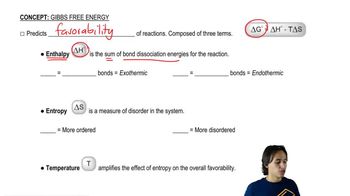
Gibbs Free Energy (∆G°) is a thermodynamic potential that measures the maximum reversible work obtainable from a thermodynamic system at constant temperature and pressure. It indicates the spontaneity of a reaction; a negative ∆G° suggests that the reaction is spontaneous, while a positive value indicates non-spontaneity. In the context of conformational changes, it helps predict the stability of different molecular conformations.
Video consigliato:
05:02
Breaking down the different terms of the Gibbs Free Energy equation.

Conformational Analysis

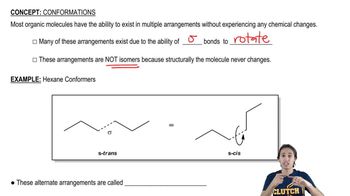
Conformational analysis is the study of the different spatial arrangements of atoms in a molecule that can be interconverted by rotation around single bonds. In cyclohexane derivatives, such as methylcyclohexane, the axial and equatorial positions significantly influence the molecule's stability due to steric interactions. Understanding these conformations is crucial for predicting the energy changes associated with their interconversion.
Video consigliato:
03:29
Understanding what a conformer is.

Temperature and Reaction Conditions

Temperature plays a vital role in determining the Gibbs Free Energy and the equilibrium between different molecular conformations. At 25 °C, the standard conditions for thermodynamic calculations, the energy difference between axial and equatorial conformations can be quantitatively assessed. This temperature is often used as a reference point for calculating thermodynamic properties, making it essential for accurate predictions in organic chemistry.
Video consigliato:
Percorso guidato
3:22
EAS Reactions of Pyridine Concept 3